
Blog / Barberino Nissan Service

Blog

All Barberino Nissan Service Wallingford Nissan Dealer New Nissan Vehicles Buying Guides Financing & Insurance Model Comparisons Nissan Altima Nissan ARYIA Nissan Frontier Nissan Information Nissan Pathfinder Nissan Rogue Wallingford Used Cars Around Town Nissan LEAF Wallingford Local Wallingford Restaurants Buy vs. Lease Community Events Maintenance & Service Nissan KICKS Nissan Sentra Trade-In & Upgrade Programs Transmission Care & Repair Wallingford Nissan Service
Gray Mazda SUV driving on a winding, wet asphalt road through a sun-drenched forest. (Representative image for illustration purposes only. Actual vehicle may vary based on trim and configuration.)

How the Nissan Rogue Drive Mode Selector Optimizes Your Connecticut Commute

Mastering the Drive Mode Selector in Your 2026 Nissan Rogue As a Service Director here at Barberino Nissan with over 10 years of experience, I spend a lot of time showing drivers how to get the most out of their vehicles. The modern Drive Mode Selector, often referred to as D-Mode, is one of the most versatile features on today's crossovers. This system alters throttle response, steering effort, and transmission behavior to match road conditions. Selecting the right setting can make a daily commute much more comfortable. Our team often shows buyers how to rotate the console-mounted dial to toggle between different modes. The instrument cluster displays a unique color and graphic for each selected mode to confirm the change. Drivers looking for a highly capable crossover can explore the new Nissan Rogue to see this technology in action. We also carry a wide selection of quality vehicles in our pre-owned Nissan inventory. These new Nissan crossovers provide excellent versatility for all kinds of travel. To learn more about these drive settings, feel free to give our service department a call at (203) 265-1611 or stop by our Wallingford showroom. Table of Contents Understanding the Difference Between Shifter Drive Positions and Selectable Drive Modes Maximizing Fuel Economy with Eco Mode on the Commute to Hartford Balancing Power and Efficiency When Using Sport Mode How Snow and Off-Road Modes Coordinate with Intelligent All-Wheel Drive Finding and Test Driving the 2026 Nissan Rogue Understanding the Difference Between Shifter Drive Positions and Selectable Drive Modes A common point of confusion for many drivers is the difference between shifting the transmission into Drive and selecting a specific drive mode. Shifting into "D" on the electronic shifter simply engages the forward gears of the Xtronic CVT to move the vehicle. The transmission then manages gear ratios automatically based on vehicle speed and throttle input. Selectable drive modes alter the overall driving dynamics rather than just engaging the transmission. These modes adjust how quickly the engine responds to the gas pedal and how the transmission behaves. Every trim level, including the S, SV, Dark Armor, Rock Creek, SL, and Platinum, utilizes this advanced electronic management. Under the hood, the standard 1.5-liter VC-Turbo three-cylinder engine produces 201 hp and 225 lb-ft of torque. This power is routed through the Xtronic CVT to either the front wheels or the all-wheel-drive system. If you want to explore our current options, you can browse our used vehicle inventory or get pre-approved online to start the purchasing process. Our online payment calculator is also available to help plan a monthly budget. Engine & Performance Powertrain specs by trim Feature Dark Armor Platinum Rock Creek S SL SV Engine 1.5L 1.5L 1.5L 1.5L 1.5L 1.5L Horsepower 201 hp 201 hp 201 hp 201 hp 201 hp 201 hp Torque 225 lb-ft 225 lb-ft 225 lb-ft 225 lb-ft 225 lb-ft 225 lb-ft Transmission Xtronic CVT Xtronic CVT Xtronic CVT Xtronic CVT Xtronic CVT Xtronic CVT Drivetrain Front-wheel drive All-wheel drive All-wheel drive Front-wheel drive Front-wheel drive Front-wheel drive Maximizing Fuel Economy with Eco Mode on the Commute to Hartford Commuting along the busy interstate corridors toward Hartford requires a vehicle that can balance steady cruising with fuel-saving technology. Eco mode is specifically engineered to maximize efficiency during these long drives. This setting modifies throttle sensitivity, requiring a bit more pedal pressure to accelerate rapidly, which naturally encourages smoother driving habits. The climate control system also adjusts slightly in Eco mode to reduce the load on the engine. These subtle changes help the vehicle achieve its EPA-estimated fuel economy ratings of 29 city / 36 hwy mpg for front-wheel-drive models. On all-wheel-drive models, the rating sits at a highly competitive 31 mpg combined. When commuters come into our service bay, they often ask me if keeping the vehicle in Eco mode full-time actually makes a difference on their daily highway commute. I always explain that consistent use of this setting over long distances yields noticeable savings at the pump. Drivers interested in a highly efficient commuter can browse our selection of new Nissan models. You can also read about why local drivers choose us for their automotive needs, and check out our latest service and parts specials to keep your vehicle running efficiently. Fuel Economy Fuel economy and range by trim Feature Dark Armor Platinum Rock Creek S SL SV MPG 29 city / 36 hwy / 32 combined 28 city / 35 hwy / 31 combined 27 city / 32 hwy / 29 combined 29 city / 36 hwy / 32 combined 29 city / 36 hwy / 32 combined 29 city / 36 hwy / 32 combined Balancing Power and Efficiency When Using Sport Mode Does engaging Sport mode on a regular basis drastically hurt your fuel economy? The short answer is yes, because Sport mode is designed to prioritize performance over efficiency. This setting sharpens throttle response, meaning the vehicle accelerates more quickly with less pedal input. The Xtronic CVT also holds higher engine speeds longer, keeping the engine in the meat of its power band. This is highly useful when merging onto fast-moving parkways or passing slower vehicles. The standard 1.5-liter VC-Turbo engine feels incredibly responsive under these conditions, delivering its full 201 hp and 225 lb-ft of torque. Because Sport mode keeps the engine running at higher revolutions, fuel consumption naturally increases. I recommend using Sport mode selectively when the driving situation demands immediate power, rather than leaving it active for everyday cruising. If you are ready to take the next step toward ownership, you can get pre-qualified with Capital One through our secure portal. You can also meet our dedicated team of professionals who are ready to assist with any questions. How Snow and Off-Road Modes Coordinate with Intelligent All-Wheel Drive As the seasons transition and bring unpredictable weather to New Haven, having a system that actively manages traction becomes essential. On models equipped with Intelligent All-Wheel Drive, the Drive Mode Selector includes dedicated Snow and Off-Road settings. These modes work in tandem with the vehicle's traction control and braking systems to maintain stability. Snow mode is calibrated to prevent wheel spin on slippery, icy, or slushy roads. It softens the initial throttle response so that power is applied gently to the tires, reducing the likelihood of breaking traction. The Intelligent All-Wheel Drive system also pre-emptively routes power to the rear wheels to help the vehicle pull away smoothly from a stop. Off-Road mode is designed for loose surfaces such as dirt, sand, or gravel. This setting optimizes torque distribution across all four wheels to maintain forward momentum over uneven ground. To ensure your all-wheel-drive system is fully prepared for seasonal changes, you can schedule a service appointment with our factory-trained technicians. We also offer a variety of monthly specials on maintenance and parts to help keep your vehicle in peak operating condition. Finding and Test Driving the 2026 Nissan Rogue Finding the right crossover involves experiencing how these drive modes handle on local roads. The lineup offers a range of options to suit different budgets and driving preferences. The entry-level S trim starts at an MSRP of $29,090, while the popular SV is priced at $30,490 and the adventure-oriented Rock Creek comes in at $33,690. For those seeking premium comfort, the SL starts at $35,290, and the top-tier Platinum AWD is priced at $39,390. The newly introduced Dark Armor trim is also available starting at an MSRP of $33,340. Every model comes backed by a comprehensive 3-year/36,000-mile basic warranty and a 5-year/60,000-mile powertrain warranty for peace of mind. Our team is ready to help you find the perfect model and configuration for your lifestyle. Before visiting, you can value your trade-in online to see what your current vehicle is worth. When you are ready for a test drive, you can get interactive directions to our dealership or speak with us directly by calling (203) 265-1611. Pricing *Pricing by trim* Feature Dark Armor Platinum Rock Creek S SL SV Base MSRP $33,340 $39,390 $33,690 $29,090 $35,290 $30,490 © 2026 Barberino Nissan. All rights reserved. { "@context": "https://schema.org", "@graph": [ { "@type": "NewsArticle", "@id": "#article", "headline": "How the Nissan Rogue Drive Mode Selector Optimizes Your Connecticut Commute", "datePublished": "2026-07-26T17:20:59.481Z", "dateModified": "2026-07-26T17:24:16.010Z", "author": { "@id": "#author" }, "publisher": { "@id": "#dealer" }, "wordCount": 1475, "description": "Explore how the Nissan Rogue Drive Mode Selector optimizes performance by adjusting throttle response and steering for different road conditions and driving styles." }, { "@type": "AutoDealer", "@id": "#dealer", "name": "Barberino Nissan", "url": "https://www.barberinonissan.com", "telephone": "+12032651611", "sameAs": [ "https://maps.google.com/?cid=8051926047023563901" ], "address": { "@type": "PostalAddress", "streetAddress": "505 N Colony Rd", "addressLocality": "Wallingford", "addressRegion": "CT", "postalCode": "06492", "addressCountry": "US" }, "openingHours": [ "Mo 09:00-20:00", "Tu 09:00-20:00", "We 09:00-20:00", "Th 09:00-20:00", "Fr 09:00-19:00", "Sa 09:00-18:00" ] } ] }

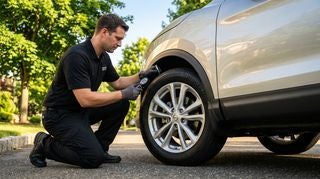
A technician in a black uniform kneels to check the tire tread depth of a silver SUV parked on a street. (Representative image for illustration purposes only. Actual vehicle may vary based on trim and configuration.)

Understanding Your Nissan TPMS Warning: A Summer Driving Safety Interview

Today, we're interviewing the Service Manager at Barberino Nissan, who brings years of technical expertise to one of the most common questions we hear during the warmer months. As the local authority on vehicle maintenance, he is uniquely qualified to explain the nuances of the Tire Pressure Monitoring System and why summer heat in the Northeast demands extra vigilance. In this discussion, readers will learn how to decipher dashboard alerts, the mechanical risks of ignoring tire pressure changes, and how Nissan technology simplifies routine maintenance for every driver. Q: When a driver sees that horseshoe-shaped light on their dashboard, what is their Nissan actually trying to communicate about the vehicle's status? A: That icon is the universal symbol for your Tire Pressure Monitoring System, or TPMS. When it illuminates, your vehicle is alerting you that at least one tire has drifted significantly away from the manufacturer's recommended inflation level. Specifically, most systems are calibrated to trigger a warning when the pressure drops by about 25 percent below the cold inflation PSI listed on your driver-side door jamb. Whether you are driving a new Nissan Sentra or a rugged new Nissan Frontier, the system is constantly measuring the air density inside your tires to ensure your contact patch with the road remains optimal. It is a common misconception that the light only means you have a flat. While a puncture will certainly trigger it, the alert often stems from gradual pressure loss or environmental changes. For those driving electric Nissan models like the new Nissan LEAF, maintaining correct pressure is even more vital because under-inflation creates rolling resistance that directly impacts your battery range. We often see owners of new Nissan crossovers such as the new Nissan Rogue or the new Nissan Kicks come in thinking they need a repair, when in reality, they just need a precise adjustment to match the 33–41 psi range typical for those models. If you're unsure where to find your specific specs, you can always stop by for a quick check. Our team is available at (203) 265-1611 to answer questions, or you can find us at 505 N Colony Rd in Wallingford. Whether you are maintaining new Nissan sedans like the new Nissan Altima or larger Nissan models with 3rd row seating like the new Nissan Pathfinder, new Nissan Armada, or the new Nissan Murano, keeping that light off is about safety and efficiency. We even offer specialized Nissan EV maintenance and a Nissan Express Service program to handle these checks quickly. If you're driving one of our pre-owned Nissan inventory vehicles or a heavy-duty option from our new Nissan trucks, the TPMS remains your first line of defense against tire failure. Q: How does the Tire Pressure Monitoring System actually function to protect a driver during their daily commute? A: The system works through small, battery-powered sensors mounted inside each wheel. These sensors transmit real-time data to your vehicle's computer. In a modern Nissan, this isn't just about a dummy light; many models provide a live readout of the exact PSI in each individual tire on your digital instrument cluster. This allows you to see if one tire is slowly losing air before it ever reaches that 25 percent threshold. By catching low pressure early, the system prevents the tire sidewalls from over-flexing, which generates excessive heat and can lead to a catastrophic blowout. Beyond safety, there is a major longevity component. When your tires are under-inflated, the edges of the tread wear down much faster than the center, forcing you to replace tires prematurely. I always explain to owners why buying from us includes the benefit of our factory-trained technicians who understand these calibrations perfectly. If you notice your TPMS light is persistent, it’s best to schedule service rather than just adding air repeatedly. We want to ensure your sensors are communicating correctly and that your tires are wearing evenly. For those who have just started their ownership journey and were able to get pre-approved for their vehicle, keeping up with these small maintenance alerts is the best way to protect that investment over the long haul. Q: We often hear that summer heat can cause tire issues. How does a rise in temperature specifically affect tire pressure and the TPMS? A: High ambient temperatures have a direct physical impact on the air inside your tires. As a general rule of thumb, tire pressure increases by about 1 psi for every 10°F rise in temperature. On a hot afternoon in Meriden, the pavement temperature can be significantly higher than the air temperature, causing the air inside the tire to expand rapidly. This can lead to over-inflation, which makes the tire stiffer and reduces the size of the contact patch, potentially affecting your braking distance and handling. "The gap between a simple warning and a dangerous blowout narrows significantly when the pavement is baking at triple digits." Furthermore, heat is the primary enemy of tire rubber. If you are already running slightly low on air, the friction from the tire sidewall flexing combined with the external summer heat can cause the tire to reach critical temperatures very quickly. This is why we see more blowouts in July and August than at any other time of year. When you meet the team in our service department, they’ll tell you that checking your pressure "cold"—meaning before you’ve driven more than a mile—is the only way to get an accurate reading. The TPMS is designed to account for some of this heat expansion, but it cannot replace a manual check with a high-quality gauge during a heatwave. Q: What does it mean if the TPMS light flashes for a minute when you start the car before staying on solid, and is that different from a standard low-pressure warning? A: That is a very important distinction. A solid light from the moment you turn the key almost always means low pressure in at least one tire. However, if the light flashes for 60 to 90 seconds and then remains solid, the vehicle is telling you there is a fault with the TPMS system itself. This usually points to a dead sensor battery or a sensor that has been damaged. Since these sensors live inside the harsh environment of the wheel, they are subject to vibration and road debris, and their internal batteries typically last between five and ten years. Ignoring a flashing light means you no longer have an active safety net monitoring your tires. If you have a slow leak while driving through Cheshire, the system won't be able to warn you. We recommend getting a diagnostic scan as soon as you see that flashing pattern. Our technicians use specialized tools to "ping" each sensor and identify exactly which one has failed without having to dismount every tire. We often include checks like these in our ofertas mensuales for service, ensuring that your safety systems are just as healthy as your engine and brakes. Q: Nissan has a unique feature called Easy-Fill Tire Alert. How does that help drivers maintain the correct pressure? A: This is one of my favorite pieces of "helpful tech." Traditionally, you’d have to fumble with a handheld gauge, adding a little air, checking the gauge, and repeating the process. With Nissan Easy-Fill Tire Alert, you simply put the vehicle in park with the ignition on and start adding air. The vehicle monitors the pressure in real-time and flashes the hazard lights to show it's receiving air. Once you hit the exact PSI required for that specific model—like the 35 psi recommended for a 2026 Nissan Pathfinder —the horn will give a friendly chirp. If you accidentally over-inflate the tire, the hazard lights flash faster and the horn sounds again, telling you to bleed some air out. It removes all the guesswork and ensures you aren't driving on over-inflated tires, which can be just as problematic for tread wear as under-inflation. It’s a standard feature that adds massive value to the ownership experience. While some people use a contact us for payment information to budget for their monthly costs, they often forget that features like this save real money over time by extending the life of a $200 tire. It’s a perfect example of how Nissan integrates service-minded technology directly into the driver's hands. Q: When is it necessary to recalibrate the TPMS, and what should drivers expect when they bring their vehicle to Barberino Nissan for tire care? A: You should generally recalibrate or reset the system after every tire rotation or when you replace a sensor. In many Nissan models, the system is self-learning, meaning it will pick up the new sensor positions after you drive at speeds above 16 mph for several minutes. However, if the light stays on after you’ve verified all pressures are correct, a manual reset through the vehicle’s settings menu or a professional calibration at the dealership is required. We see this often during seasonal transitions where the "mixed" climate here causes pressure swings that confuse an older sensor. When you visit us, we don’t just "air them up." We perform a full visual inspection of the tread and sidewalls to look for heat-related cracking or "bulges" that could indicate internal structural failure. We also check our latest service and parts specials to see if you're due for a rotation or alignment, which are critical for keeping those TPMS sensors accurate. If you need assistance, you can always give our service team a call or get directions to our Wallingford facility. We are here to ensure that your summer road trips are defined by the destination, not by a roadside breakdown caused by an ignored dashboard light. Maintaining proper tire pressure is one of the simplest yet most effective ways to ensure your Nissan remains safe, efficient, and reliable throughout the summer months. As we've discussed, the TPMS warning light is a vital communication tool that helps prevent premature tire wear and dangerous blowouts, especially when temperatures begin to climb. By understanding the difference between a low-pressure alert and a system fault, and by utilizing convenient features like the Easy-Fill Tire Alert, you can drive with confidence. Our certified technicians at Barberino Nissan are always ready to provide professional diagnostics, sensor replacements, and comprehensive tire inspections to keep your vehicle in peak condition. If your warning light is on or if you haven't had your tires checked recently, we encourage you to visit our service center today to stay ahead of the heat. © 2026 Barberino Nissan. All rights reserved. { "@context": "https://schema.org", "@graph": [ { "@type": "NewsArticle", "@id": "#article", "headline": "Understanding Your Nissan TPMS Warning: A Summer Driving Safety Interview", "datePublished": "2026-06-24T01:34:13.326Z", "dateModified": "2026-06-24T01:38:20.559Z", "author": { "@id": "#author" }, "publisher": { "@id": "#dealer" }, "wordCount": 1777, "description": "Learn how the Nissan Tire Pressure Monitoring System works and why summer heat triggers alerts. This guide covers essential safety tips for maintaining tire pressure." }, { "@type": "AutoDealer", "@id": "#dealer", "name": "Barberino Nissan", "url": "https://www.barberinonissan.com", "telephone": "+12032651611", "sameAs": [ "https://maps.google.com/?cid=8051926047023563901" ], "address": { "@type": "PostalAddress", "streetAddress": "505 N Colony Rd", "addressLocality": "Wallingford", "addressRegion": "CT", "postalCode": "06492", "addressCountry": "US" }, "openingHours": [ "Mo 09:00-20:00", "Tu 09:00-20:00", "We 09:00-20:00", "Th 09:00-20:00", "Fr 09:00-19:00", "Sa 09:00-18:00" ] }, { "@type": "QAPage", "@id": "#qapage", "name": "Understanding Your Nissan TPMS Warning: A Summer Driving Safety Interview", "description": "An in-depth interview with the Service Manager at Barberino Nissan explaining the Tire Pressure Monitoring System (TPMS), its warnings, and maintenance tips for summer driving safety.", "mainEntity": { "@type": "Question", "name": "When a driver sees that horseshoe-shaped light on their dashboard, what is their Nissan actually trying to communicate about the vehicle's status?", "text": "That icon is the universal symbol for your Tire Pressure Monitoring System, or TPMS. When it illuminates, your vehicle is alerting you that at least one tire has drifted significantly away from the manufacturer's recommended inflation level. Specifically, most systems are calibrated to trigger a warning when the pressure drops by about 25 percent below the cold inflation PSI listed on your driver-side door jamb. Whether you are driving a new Nissan Sentra or a rugged new Nissan Frontier, the system is constantly measuring the air density inside your tires to ensure your contact patch with the road remains optimal. It is a common misconception that the light only means you have a flat. While a puncture will certainly trigger it, the alert often stems from gradual pressure loss or environmental changes. For those driving electric Nissan models like the new Nissan LEAF, maintaining correct pressure is even more vital because under-inflation creates rolling resistance that directly impacts your battery range. We often see owners of new Nissan crossovers such as the new Nissan Rogue or the new Nissan Kicks come in thinking they need a repair, when in reality, they just need a precise adjustment to match the 33–41 psi range typical for those models. If you're unsure where to find your specific specs, you can always stop by for a quick check. Our team is available at (203) 265-1611 to answer questions, or you can find us at 505 N Colony Rd in Wallingford. Whether you are maintaining new Nissan sedans like the new Nissan Altima or larger Nissan models with 3rd row seating like the new Nissan Pathfinder, new Nissan Armada, or the new Nissan Murano, keeping that light off is about safety and efficiency. We even offer specialized Nissan EV maintenance and a Nissan Express Service program to handle these checks quickly. If you're driving one of our pre-owned Nissan inventory vehicles or a heavy-duty option from our new Nissan trucks, the TPMS remains your first line of defense against tire failure.", "answerCount": 1, "datePublished": "2026-06-24T01:34:13.326333+00:00", "author": { "@type": "Organization", "name": "Barberino Nissan" }, "acceptedAnswer": { "@type": "Answer", "text": "That icon is the universal symbol for your Tire Pressure Monitoring System, or TPMS. When it illuminates, your vehicle is alerting you that at least one tire has drifted significantly away from the manufacturer's recommended inflation level. Specifically, most systems are calibrated to trigger a warning when the pressure drops by about 25 percent below the cold inflation PSI listed on your driver-side door jamb. Whether you are driving a new Nissan Sentra or a rugged new Nissan Frontier, the system is constantly measuring the air density inside your tires to ensure your contact patch with the road remains optimal. It is a common misconception that the light only means you have a flat. While a puncture will certainly trigger it, the alert often stems from gradual pressure loss or environmental changes. For those driving electric Nissan models like the new Nissan LEAF, maintaining correct pressure is even more vital because under-inflation creates rolling resistance that directly impacts your battery range. We often see owners of new Nissan crossovers such as the new Nissan Rogue or the new Nissan Kicks come in thinking they need a repair, when in reality, they just need a precise adjustment to match the 33–41 psi range typical for those models. If you're unsure where to find your specific specs, you can always stop by for a quick check. Our team is available at (203) 265-1611 to answer questions, or you can find us at 505 N Colony Rd in Wallingford. Whether you are maintaining new Nissan sedans like the new Nissan Altima or larger Nissan models with 3rd row seating like the new Nissan Pathfinder, new Nissan Armada, or the new Nissan Murano, keeping that light off is about safety and efficiency. We even offer specialized Nissan EV maintenance and a Nissan Express Service program to handle these checks quickly. If you're driving one of our pre-owned Nissan inventory vehicles or a heavy-duty option from our new Nissan trucks, the TPMS remains your first line of defense against tire failure.", "upvoteCount": 0, "datePublished": "2026-06-24T01:34:13.326333+00:00", "author": { "@type": "Organization", "name": "Barberino Nissan" } } }, "publisher": { "@type": "Organization", "@id": "#dealer", "name": "Barberino Nissan", "url": "https://www.barberinonissan.com" }, "datePublished": "2026-06-24T01:34:13.326333+00:00", "dateModified": "2026-06-24T01:38:20.559789+00:00", "inLanguage": "en" } ] }

Dog looking out window

Get Your Nissan Car Ready for Spring: Essential Service Tasks

As winter fades and warmer weather arrives, it's crucial to ensure your Nissan car is in top shape for the spring season. Here are some essential spring Nissan service tasks at Barberino Nissan to ensure a safe and enjoyable driving experience. more Oil and Filter Change Regular oil changes are vital for maintaining your Nissan car's engine health. The cold temperatures of winter can cause your engine oil to thicken, making it less effective in lubricating and protecting your engine components. As spring arrives, it's essential to schedule an oil change and oil filter replacement to ensure optimal engine performance and longevity. Tire Inspection and Rotation Temperature fluctuations can significantly affect your tires' pressure and wear patterns. It's essential to inspect your tires for proper inflation, wear, and damage as the seasons change. Additionally, rotating your tires regularly promotes even wear, which extends their lifespan and enhances overall vehicle handling. If you've been using winter tires, it's time to switch back to all-season or summer tires for improved traction and fuel efficiency. Battery Check Cold weather can significantly affect your car battery's performance, making it essential to test your battery's charge and condition as spring approaches. If your battery shows signs of wear or weak performance, consider replacing it to avoid being stranded with a dead battery. Fluid Level Checks Inspecting and topping off all essential fluids is a critical maintenance task for your vehicle’s smooth operation. Our technicians will check the levels of your coolant, transmission fluid, brake fluid, and power steering fluid, and top off or replace them as needed to maintain optimal performance. Nissan Service at Barberino Nissan Proper spring maintenance is crucial to keeping your Nissan in peak condition, ensuring a safe and enjoyable driving experience. Our technicians at Barberino Nissan can tackle these essential service tasks, and you'll be ready to hit the road and make the most of the warmer weather. Schedule service today!

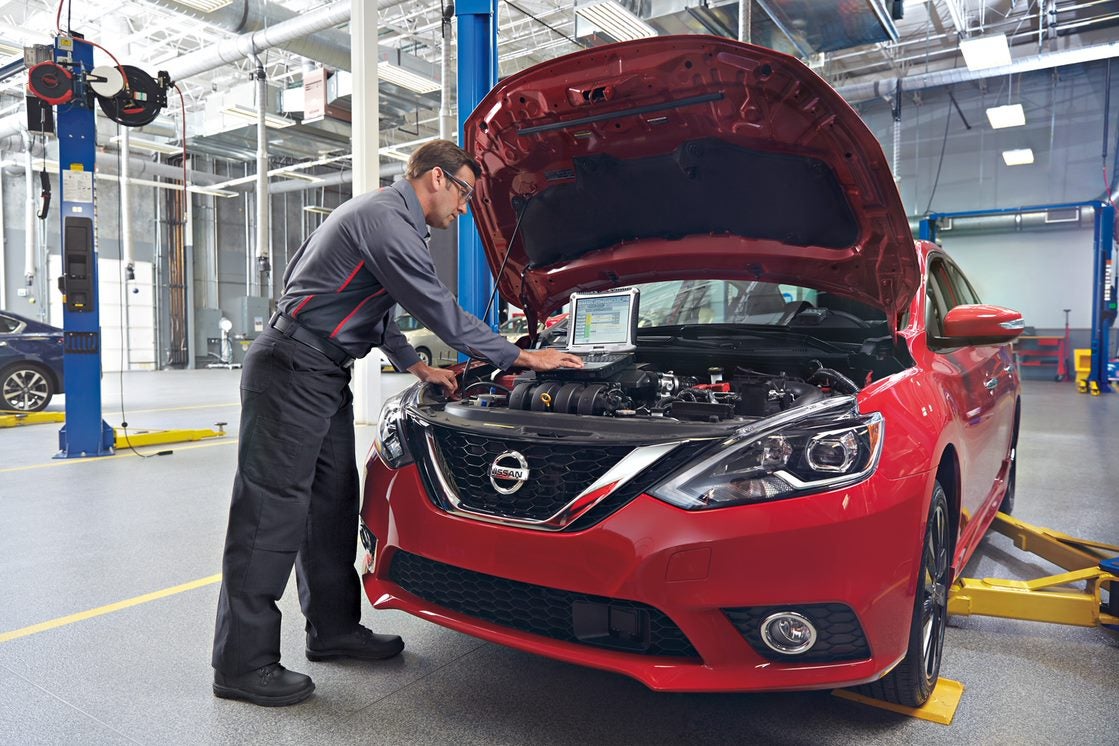
nissan inspection

The Importance of Nissan Maintenance

Everybody wants their new vehicle to last as long as possible and continue to perform like it did when it was first driven off the dealership lot. While Nissan cars are known for being long-lasting, durable, and tough, it’s up to the driver to properly maintain the vehicle. There are few things more important for vehicle health than getting regular maintenance, and here at our Nissan service center at Barberino Nissan, our certified mechanics are happy to talk about the importance of Nissan maintenance. Why is Nissan Maintenance Necessary? Keeping up with your Nissan car’s maintenance schedule not only ensures its safety and dependability — it can also increase both performance and fuel efficiency, saving you money at the pump. Nissan vehicles are created with the intention that they receive certain types of maintenance and specific intervals. The maintenance schedule for your make and model can be found in the manual. What Happens if I Neglect Maintenance? Skipping regular maintenance is not something that mechanics recommend doing. While it may appear that nothing is wrong with your vehicle, regular maintenance is what prevents issues from popping up. For example, skipping regular Nissan oil changes can cause your car’s engine oil to get dirty and old, leading to decreased efficiency and performance. What Types of Services Qualify as Regular Maintenance? What exactly are we referring to when we talk about regular maintenance? These are some services that our mechanics perform regularly: Oil changes Tire rotations General inspections Brake checks Battery checks Windshield wiper blade checks A/C and heater checks Now that you know how important regular Nissan maintenance is, schedule your service appointment at Barberino Nissan today. We’ll make sure your Nissan car stays in top shape for years to come.

nissan service checklist

Nissan Service Checklist

Hartford-area drivers who schedule Barberino Nissan service can rest assured that they can trust our Nissan-trained technicians to deliver it quickly and conveniently. Read on to learn more about the importance of regular maintenance and the types of services included in a routine Nissan service checklist. Why get Regular Maintenance? Keeping your vehicle running smoothly and safely, and promoting its longevity, is greatly influenced by you: the owner. Keeping up with routine service will ensure an enjoyable experience by making sure that things like tires, oil, fluid level, and brakes are in tip-top shape. It also helps catch problems before they arise, which will save you time and money in the long run. Nissan Service Tasks There are a variety of Nissan service tasks that need to be completed regularly. A schedule can be determined based on various factors such as your Nissan make, model, and driving habits and discussed with your Barberino Nissan service specialist. Common service tasks include maintaining: Tires Brakes Fluid-Levels Battery Engine Oil and Filter Lights Belts, Hoses, and Filters Windshield Wipers Trust Barberino Nissan Service Near Hartford, CT At Barberino Nissan, we know you have a busy life, and your time is valuable. That’s why we’re open six days a week and offer convenient online scheduling. We also aim to make your experience as hassle-free as possible by offering complimentary loaner vehicles, shuttle services, and a comfortable lounge with free snacks and Wi-Fi. Our Nissan-trained technicians can perform all the Barberino Nissan service tasks you may need from routine maintenance to large repairs, and we always use only genuine Nissan parts. We look forward to serving you and keeping your Nissan car on the road for miles to come!

Transmission | Barberino Nissan in Wallingford, CT

Does Your Car Need a Transmission Repair?

If you're considering putting off your car's transmission repair because it seems to be working fine, you better think twice. Over time, this crucial part of your car can start malfunctioning, causing considerable problems. Additionally, a malfunctioning transmission can lead to many mechanical issues that put you and others at risk. With this in mind, here's an overview of these repairs to ensure your car is always in its best possible condition. Performing a Repairs Diagnose The first thing you should check if you're wondering whether your car needs servicing is your transmission fluid levels. You can check the levels yourself if you have experience repairing cars. All-in-all, it's always better to let a mechanic conduct the check-up on the off chance that you miss something. more If the fluid levels are low, it's time to replace them. However, if they turn out to be normal and the car is still not running smoothly, there may be an issue with the system that brings the fluid to the engine. Another symptom that indicates your car needs some repair is how smooth the shifting is. Sometimes the parts that compose your car's transmission can wear out over time, causing problems when you try to shift gears. The Differences Between Automatic and Manual Cars When it comes to cars, there are two main types of transmissions, which are automatic and manual. When repairing an automatic transmission, replacing parts such as the torque converter, transfer case, and fluid pan is often necessary. A manual transmission is more straightforward and usually does not need the same number of replacements and typically requires only a fluid change unless there are faulty components. The significant difference between automatic and manual transmissions is how they are designed. Automatic cars have components that allow the engine to shift faster than its counterpart. This difference allows for better acceleration and fuel economy on highways. Manual vehicles enable the driver to choose when to shift, which is better for specialized vehicles. They have the same goal but work differently, making their repairs quite distinctive. The Cost of Repairs The cost of repairing a transmission depends on how damaged it is. A simple fluid change might go for only a few hundred dollars, but the price scales accordingly if leaks or certain parts need to be replaced. Considering this, the average cost of a complete repair can easily hit $2,500. With such prices in mind, it's no surprise that people are starting to worry about even the slightest sign of a problem. Don't let time turn a routine service into a hefty repair bill. To have certified technicians examine and repair your car's transmission, visit Barberino Nissan.

Alternator | Barberino Nissan in Wallingford, CT

Does Your Nissan Need an Alternator Repair?

A failing alternator can cut off the electrical supply to your Nissan. It will also cause your battery to fail, as the battery will have to take over and supply your car's electrical demands. A car battery isn't designed to supply all your car's electrical needs, and it will also quickly fail. To prevent this situation, when you need an alternator repair, your friendly Nissan dealer in Wallingford, CT, can help you out! Check Battery Light Your dash has a battery-shaped icon that represents your car's electrical system. This light will come on if there's a problem with any part of your car's electrical system, including the battery and the alternator. Your car has numerous sensors, each of which is attached to a specific component. The sensors are very sensitive and can detect minute changes in their attached component. more When a problem is identified by a sensor, the battery warning light will come on. A worn alternator can trigger this light when its power output drops. An alternator produces approximately 14.5 volts, which is more than sufficient to supply your car's electrical needs. When the power output drops below 13 volts, the alternator is failing. Screeching Noises from the Engine The alternator is powered by the alternator belt. This belt is connected to the crankshaft, and the turning of the crankshaft causes this belt to move at high speed. The belt runs across a series of pulleys, and this activates the components connected to them. The alternator belt is made from reinforced rubber, and it's designed to last for a long time. We test the belt as part of your service schedule to ensure that it's in good condition and that it's tensioned correctly. The constant movement of the belt can lead to its loosening slightly. A pulley could also jam, and this may cause the belt to run slightly off track. A screeching sound means the belt is jamming on something as it moves. We will check the condition of your belt and the pulleys. Slow Accessories Your Nissan has numerous accessories which draw their power from the alternator. A healthy alternator can easily supply all your car's power demands, but when the alternator starts to fail this causes a problem. Gradually, a weakening alternator will supply less and less power. The lack of sufficient power will start to cause strange behavior in your electrical system. A car window, for example, may suddenly open and close very slowly, or the radio may fail to switch on. These are some of the possible signs that your alternator isn't generating enough power. Our technicians will test your alternator, and we can replace it if it's failing. An alternator always gives signs that it has a problem. If you experience any strange electrical behavior, call our service department right away at Barberino Nissan. We can diagnose and repair the problem, and you'll be on the road again in no time!

Contact Us

Fill out this form below and we'll contact you shortly
*Required Fields