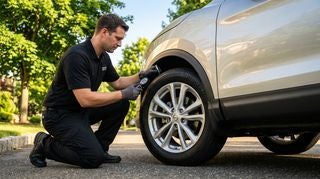


Tire balancing corrects weight distribution imbalances in the wheel-and-tire assembly to eliminate high-speed vibrations, whereas a wheel alignment corrects the physical angles of your vehicle suspension so your tires track straight and make proper contact with the road. Today, we sit down with our Service Director at Barberino Nissan, who brings over a decade of specialized automotive service experience, to discuss why autumn is the critical season for checking suspension geometry and tire health on your Nissan.
Q: What is the difference between tire balancing and wheel alignment?
A: Drivers frequently lump tire balancing and wheel alignment into the same category, but they solve two entirely different mechanical issues within your vehicle's chassis. Tire balancing focuses on mass distribution across the rotating wheel assembly. When a tire is mounted onto a wheel, micro-variations in rubber density or alloy casting create subtle heavy spots. Using specialized electronic balancing machinery, our technicians place small weight counterbalances along the rim so the assembly rotates evenly at high speeds without inducing steering-wheel wobble or cabin vibration.
A wheel alignment, by contrast, adjusts the precise mechanical angles where your tires contact the road surface. Our certified technicians measure and calibrate three primary angles: camber, which is the inward or outward tilt of the tire when viewed from the front; caster, which is the slope of the steering axis that dictates straight-line stability; and toe, which is the angle at which the tires point inward or outward relative to the vehicle centerline. When suspension components absorb impacts from summer travel, these angles shift out of factory specification. Correcting alignment prevents rapid tread wear and keeps your vehicle tracking straight along the highway.
Understanding this distinction helps prevent unnecessary component damage and premature tire replacement costs over time. While imbalanced tires cause a rhythmic vibration at highway speeds, misaligned suspension angles quietly scrub the rubber off your tire shoulders without immediate pedal or steering feedback. To keep your vehicle driving safely, you can schedule a routine service appointment at our Wallingford service center or give a quick call to our service team to have your chassis system thoroughly inspected.
Q: Why is October the ideal time for a fall alignment check on your Nissan?
A: October represents a pivotal transition period for vehicle maintenance in Connecticut because fluctuating ambient temperatures and shifting road conditions directly affect chassis dynamics. According to guidelines from the NHTSA, tire inflation pressure drops by approximately 1 psi for every 10°F decrease in outside air temperature. As autumn mornings cool down, underinflated tires operating on misaligned suspension geometry suffer accelerated tread degradation, reduced wet-weather braking grip, and compromised fuel efficiency.
Summer driving takes a heavy toll on suspension systems. Months of highway trips, rough pavement, construction zones, and curb contacts alter alignment specs by tiny fractions of a degree. Catching these misalignments in October ensures that your tires establish a full, even contact patch before autumn rain, decaying leaves, and early winter frost make traction scarce. Correct alignment allows tread sipes to disperse water effectively and prevents uneven wear patterns from ruining set tires ahead of cold weather.
This seasonal check is equally critical across all powertrain configurations, including gas-powered sedans and zero-emission vehicles. Electric platforms deliver instantaneous torque to the drive wheels, meaning any slight variance in toe or camber angles subjects the tire tread to extreme shear forces during acceleration. Drivers exploring our new electric Nissan inventory quickly learn that maintaining precise chassis geometry is essential for protecting range and battery efficiency on cold daily commutes into New Haven.
Q: What are the key signs that your Nissan needs an immediate wheel alignment?
A: When commuters come in after a summer of heavy driving, the question I get most often is whether a subtle steering wheel drift means they need new tires or just a suspension calibration. The most common indicator of misalignment is a vehicle pulling or drifting toward one side of the road when you relax your grip on the steering wheel along a flat, level straightaway. If you find yourself constantly applying counter-steering pressure just to maintain your lane, your suspension angles have drifted past factory tolerances.
Another clear signal is an off-center steering wheel while the vehicle travels in a straight line. If the Nissan emblem on your steering hub points at an angle while your car rolls straight, your toe alignment requires professional correction. Furthermore, drivers should inspect their tire tread regularly for signs of feathering or heel-toe wear, where one edge of the tread block wears down faster than the adjacent edge. A cupped or uneven wear pattern across the inner or outer shoulder indicates improper camber settings.
Ignoring these physical warnings accelerates tire wear dramatically and puts unnecessary strain on steering linkages, wheel bearings, and suspension struts. Drivers operating daily commuters like new Nissan Altima models rely on crisp handling and steady tracking for highway safety. Bringing your vehicle in at the first sign of pulling or uneven tread wear prevents a minor adjustment from turning into an expensive, premature tire replacement.
"When suspension angles drift even fractionally out of specification, advanced driver-assist systems lose their precise baseline reference on the road."
Q: How does a precision wheel alignment impact Nissan ProPILOT Assist and safety sensors?
A: Modern Nissan vehicles integrate advanced safety networks like Nissan Safety Shield 360 and ProPILOT Assist, which rely on a precise physical baseline to monitor surrounding traffic. These driver-assistance systems coordinate forward-facing radar, windshield-mounted cameras, and steering angle sensors to deliver features such as Automatic Emergency Braking and Lane Keep Assist. When a technician performs a wheel alignment on a sensor-equipped vehicle, adjusting mechanical tie rods and control arms changes the vehicle's physical thrust line relative to its steering wheel position.
If mechanical alignment is completed without recalibrating the steering angle sensor, the driver-assist computer receives conflicting data. The camera may see that the vehicle is centered in its lane, while the steering sensor reports that the wheel is turned a few degrees off-center. This disagreement can cause ProPILOT Assist to make improper steering corrections or trigger system fault alerts on your instrument cluster.
For this reason, a proper alignment on a modern Nissan involves both mechanical calibration and electronic sensor initialization. Factory-trained technicians use specialized diagnostic software to reset the steering angle zero-point and verify camera alignment. Adding ADAS sensor calibration typically adds 30 to 60 minutes to standard alignment service, but this step ensures your active safety systems operate with total accuracy.
Q: Will servicing your wheel alignment at an independent shop void your factory Nissan warranty?
A: Having your alignment checked or adjusted at a qualified service facility will not void your factory vehicle coverage. Under federal consumer protection laws, including the Magnuson-Moss Warranty Act, vehicle manufacturers cannot invalidate an original 3-year/36,000-mile bumper-to-bumper warranty or 5-year/60,000-mile powertrain warranty simply because routine maintenance was performed at an independent shop, provided the service was completed correctly.
However, key operational differences exist when aligning advanced, modern vehicles. Independent repair facilities often lack the model-specific factory alignment specifications, specialized Nissan calibration tools, and proprietary software required to reset internal steering angle sensors and recalibrate driver-assist systems. If an unqualified shop misadjusts suspension linkages or damages delicate electronic steering components during an alignment attempt, repairs for that subsequent mechanical or electronic damage will not be covered under factory warranty protection.
Retaining detailed service records and receipts for every alignment and tire service is essential for maintaining your vehicle history. Choosing a factory-authorized service department ensures that genuine replacement hardware is used when needed and that all suspension work adheres strictly to official technical bulletins. This factory-trained approach preserves both your mechanical coverage and peace of mind.
Q: Where can drivers find expert fall maintenance and Nissan alignment checks in Wallingford?
A: Local drivers seeking certified care for seasonal maintenance can rely directly on our dedicated service facility. Located conveniently at our convenient location on North Colony Road, our service department features computer-guided alignment bays designed to measure chassis geometry down to hundredths of a degree. Our factory-certified technicians understand the unique suspension calibration details required for every model across the lineup.
During a fall maintenance visit, our team completes a full multipoint vehicle inspection alongside your alignment check. We evaluate tire tread depth, adjust cold inflation pressures to match door-placard specifications, inspect brake pads and rotors, test battery reserve capacity, and verify wiper blade condition. Whether you drive an all-wheel drive crossover, a high-efficiency commuter sedan, or require specialized electric vehicle maintenance options, our facility provides comprehensive care tailored to your exact vehicle requirements.
Setting up your autumn alignment inspection before winter arrives is quick and straightforward. You can reserve a convenient service slot online or speak directly with an advisor by giving us a call at (203) 265-1611. Taking a proactive approach to suspension geometry in October keeps your vehicle tracking safely, protects your tire investment, and ensures confident performance on every cold-weather road ahead.