

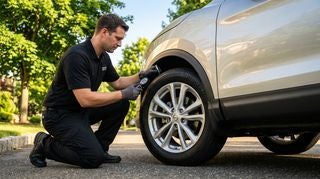
Today, we're interviewing the Service Manager at Barberino Nissan, who brings years of technical expertise to one of the most common questions we hear during the warmer months. As the local authority on vehicle maintenance, he is uniquely qualified to explain the nuances of the Tire Pressure Monitoring System and why summer heat in the Northeast demands extra vigilance. In this discussion, readers will learn how to decipher dashboard alerts, the mechanical risks of ignoring tire pressure changes, and how Nissan technology simplifies routine maintenance for every driver.
Q: When a driver sees that horseshoe-shaped light on their dashboard, what is their Nissan actually trying to communicate about the vehicle's status?
A: That icon is the universal symbol for your Tire Pressure Monitoring System, or TPMS. When it illuminates, your vehicle is alerting you that at least one tire has drifted significantly away from the manufacturer's recommended inflation level. Specifically, most systems are calibrated to trigger a warning when the pressure drops by about 25 percent below the cold inflation PSI listed on your driver-side door jamb. Whether you are driving a new Nissan Sentra or a rugged new Nissan Frontier, the system is constantly measuring the air density inside your tires to ensure your contact patch with the road remains optimal.
It is a common misconception that the light only means you have a flat. While a puncture will certainly trigger it, the alert often stems from gradual pressure loss or environmental changes. For those driving electric Nissan models like the new Nissan LEAF, maintaining correct pressure is even more vital because under-inflation creates rolling resistance that directly impacts your battery range. We often see owners of new Nissan crossovers such as the new Nissan Rogue or the new Nissan Kicks come in thinking they need a repair, when in reality, they just need a precise adjustment to match the 33–41 psi range typical for those models.
If you're unsure where to find your specific specs, you can always stop by for a quick check. Our team is available at (203) 265-1611 to answer questions, or you can find us at 505 N Colony Rd in Wallingford. Whether you are maintaining new Nissan sedans like the new Nissan Altima or larger Nissan models with 3rd row seating like the new Nissan Pathfinder, new Nissan Armada, or the new Nissan Murano, keeping that light off is about safety and efficiency. We even offer specialized Nissan EV maintenance and a Nissan Express Service program to handle these checks quickly. If you're driving one of our pre-owned Nissan inventory vehicles or a heavy-duty option from our new Nissan trucks, the TPMS remains your first line of defense against tire failure.
Q: How does the Tire Pressure Monitoring System actually function to protect a driver during their daily commute?
A: The system works through small, battery-powered sensors mounted inside each wheel. These sensors transmit real-time data to your vehicle's computer. In a modern Nissan, this isn't just about a dummy light; many models provide a live readout of the exact PSI in each individual tire on your digital instrument cluster. This allows you to see if one tire is slowly losing air before it ever reaches that 25 percent threshold. By catching low pressure early, the system prevents the tire sidewalls from over-flexing, which generates excessive heat and can lead to a catastrophic blowout.
Beyond safety, there is a major longevity component. When your tires are under-inflated, the edges of the tread wear down much faster than the center, forcing you to replace tires prematurely. I always explain to owners why buying from us includes the benefit of our factory-trained technicians who understand these calibrations perfectly. If you notice your TPMS light is persistent, it’s best to schedule service rather than just adding air repeatedly. We want to ensure your sensors are communicating correctly and that your tires are wearing evenly. For those who have just started their ownership journey and were able to get pre-approved for their vehicle, keeping up with these small maintenance alerts is the best way to protect that investment over the long haul.
Q: We often hear that summer heat can cause tire issues. How does a rise in temperature specifically affect tire pressure and the TPMS?
A: High ambient temperatures have a direct physical impact on the air inside your tires. As a general rule of thumb, tire pressure increases by about 1 psi for every 10°F rise in temperature. On a hot afternoon in Meriden, the pavement temperature can be significantly higher than the air temperature, causing the air inside the tire to expand rapidly. This can lead to over-inflation, which makes the tire stiffer and reduces the size of the contact patch, potentially affecting your braking distance and handling.
"The gap between a simple warning and a dangerous blowout narrows significantly when the pavement is baking at triple digits."
Furthermore, heat is the primary enemy of tire rubber. If you are already running slightly low on air, the friction from the tire sidewall flexing combined with the external summer heat can cause the tire to reach critical temperatures very quickly. This is why we see more blowouts in July and August than at any other time of year. When you meet the team in our service department, they’ll tell you that checking your pressure "cold"—meaning before you’ve driven more than a mile—is the only way to get an accurate reading. The TPMS is designed to account for some of this heat expansion, but it cannot replace a manual check with a high-quality gauge during a heatwave.
Q: What does it mean if the TPMS light flashes for a minute when you start the car before staying on solid, and is that different from a standard low-pressure warning?
A: That is a very important distinction. A solid light from the moment you turn the key almost always means low pressure in at least one tire. However, if the light flashes for 60 to 90 seconds and then remains solid, the vehicle is telling you there is a fault with the TPMS system itself. This usually points to a dead sensor battery or a sensor that has been damaged. Since these sensors live inside the harsh environment of the wheel, they are subject to vibration and road debris, and their internal batteries typically last between five and ten years.
Ignoring a flashing light means you no longer have an active safety net monitoring your tires. If you have a slow leak while driving through Cheshire, the system won't be able to warn you. We recommend getting a diagnostic scan as soon as you see that flashing pattern. Our technicians use specialized tools to "ping" each sensor and identify exactly which one has failed without having to dismount every tire. We often include checks like these in our ofertas mensuales for service, ensuring that your safety systems are just as healthy as your engine and brakes.
Q: Nissan has a unique feature called Easy-Fill Tire Alert. How does that help drivers maintain the correct pressure?
A: This is one of my favorite pieces of "helpful tech." Traditionally, you’d have to fumble with a handheld gauge, adding a little air, checking the gauge, and repeating the process. With Nissan Easy-Fill Tire Alert, you simply put the vehicle in park with the ignition on and start adding air. The vehicle monitors the pressure in real-time and flashes the hazard lights to show it's receiving air. Once you hit the exact PSI required for that specific model—like the 35 psi recommended for a 2026 Nissan Pathfinder—the horn will give a friendly chirp.
If you accidentally over-inflate the tire, the hazard lights flash faster and the horn sounds again, telling you to bleed some air out. It removes all the guesswork and ensures you aren't driving on over-inflated tires, which can be just as problematic for tread wear as under-inflation. It’s a standard feature that adds massive value to the ownership experience. While some people use a contact us for payment information to budget for their monthly costs, they often forget that features like this save real money over time by extending the life of a $200 tire. It’s a perfect example of how Nissan integrates service-minded technology directly into the driver's hands.
Q: When is it necessary to recalibrate the TPMS, and what should drivers expect when they bring their vehicle to Barberino Nissan for tire care?
A: You should generally recalibrate or reset the system after every tire rotation or when you replace a sensor. In many Nissan models, the system is self-learning, meaning it will pick up the new sensor positions after you drive at speeds above 16 mph for several minutes. However, if the light stays on after you’ve verified all pressures are correct, a manual reset through the vehicle’s settings menu or a professional calibration at the dealership is required. We see this often during seasonal transitions where the "mixed" climate here causes pressure swings that confuse an older sensor.
When you visit us, we don’t just "air them up." We perform a full visual inspection of the tread and sidewalls to look for heat-related cracking or "bulges" that could indicate internal structural failure. We also check our latest service and parts specials to see if you're due for a rotation or alignment, which are critical for keeping those TPMS sensors accurate. If you need assistance, you can always give our service team a call or get directions to our Wallingford facility. We are here to ensure that your summer road trips are defined by the destination, not by a roadside breakdown caused by an ignored dashboard light.
Maintaining proper tire pressure is one of the simplest yet most effective ways to ensure your Nissan remains safe, efficient, and reliable throughout the summer months. As we've discussed, the TPMS warning light is a vital communication tool that helps prevent premature tire wear and dangerous blowouts, especially when temperatures begin to climb. By understanding the difference between a low-pressure alert and a system fault, and by utilizing convenient features like the Easy-Fill Tire Alert, you can drive with confidence. Our certified technicians at Barberino Nissan are always ready to provide professional diagnostics, sensor replacements, and comprehensive tire inspections to keep your vehicle in peak condition. If your warning light is on or if you haven't had your tires checked recently, we encourage you to visit our service center today to stay ahead of the heat.