

Blog / Maintenance & Service

Preparing Your Nissan for Autumn Roads

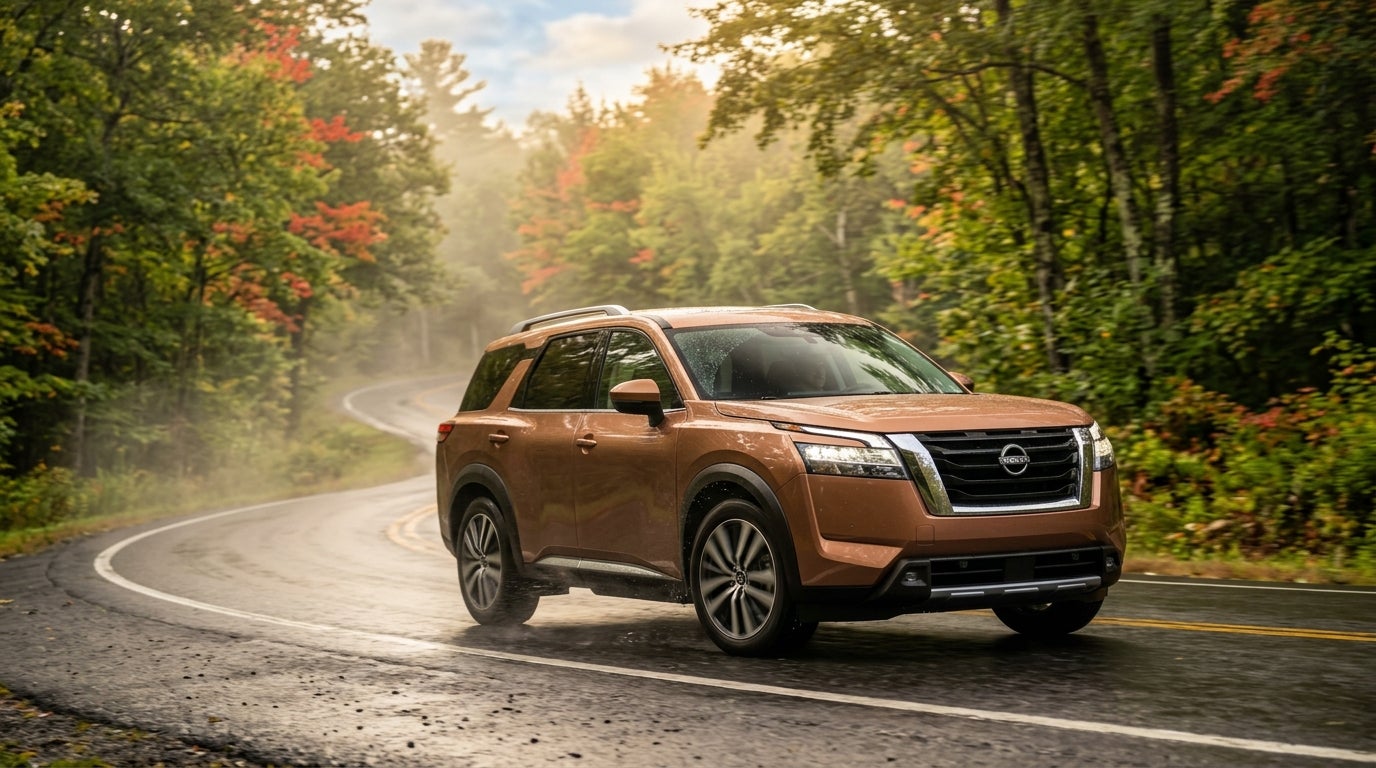
A copper Nissan SUV driving along a wet, winding forest road surrounded by autumn trees. (Representative image for illustration purposes only. Actual vehicle may vary based on trim and configuration.)

Autumn in New England brings a beautiful transition, but the combination of falling leaves, cooler mornings, and unpredictable wet weather demands proactive vehicle care. As the heat of summer fades, the physical components of your vehicle undergo stress from rapid temperature fluctuations. Preparing your vehicle before the first frost is the most effective way to ensure consistent reliability, safety, and efficiency throughout the season.

For commuters who leave their vehicles parked at the Wallingford train station during the day, the rapid shift in afternoon temperatures can stress battery chemistry and drop tire pressure before the drive home. Whether you drive a versatile crossover like the new Nissan Rogue or a family SUV like the new Nissan Pathfinder, sticking to the factory-recommended service intervals ensures your vehicle remains reliable. For those driving a daily commuter like the new Nissan Altima, keeping up with seasonal inspections prevents unexpected breakdowns. Even if you have transitioned to an electric vehicle, scheduling specialized Nissan EV maintenance ensures your battery and regenerative braking systems are optimized for the cold.

Every standard factory maintenance visit at Barberino Nissan begins with a complimentary multi-point inspection. Our certified technicians evaluate the essential systems of your vehicle, including:

  • Fluid Levels: Inspecting and topping off vital lubricants, brake fluid, engine coolant, and windshield washer fluid.
  • Braking System: Measuring brake pad thickness and checking the condition of rotors and calipers.
  • Battery Health: Testing cold cranking amps and inspecting terminals for corrosion.
  • Belts and Hoses: Checking for wear, cracking, or softening caused by summer heat.

Table of Contents

Routine Oil Changes and Tire Rotations for Fall Commutes

A drop of just ten degrees in outdoor temperature can cause tire pressure to decrease by roughly 1 psi, making routine autumn tire checks a safety necessity. Drivers navigating the coastal plain near New Haven often face damp, salty air from Long Island Sound, which accelerates the oxidation of brake rotors and causes tires to lose traction on slick morning asphalt. Our service advisors frequently note that drivers who stay on top of their 5,000-mile rotation intervals experience significantly more even tread wear and better handling when autumn rains make local roads slick.

For the majority of late-model Nissan vehicles, a standard oil change and tire rotation is recommended every 5,000 to 7,500 miles or every 6 months. Clean engine oil is critical for protecting internal engine components from friction and heat. Over time, oil breaks down and loses its lubricating properties, which can lead to carbon buildup and reduced fuel efficiency. Replacing the oil filter at the same time ensures that harmful contaminants are kept out of your engine.

To keep your vehicle performing safely, you can easily schedule a service appointment online with our factory-trained technicians. Our team uses only genuine parts and fluids that meet exact factory specifications, ensuring your vehicle receives the precise care it requires.

Understanding Severe vs. Normal Driving Conditions

Many drivers assume that severe driving conditions only apply to vehicles used for heavy commercial hauling or extreme off-road driving. However, the official Nissan maintenance guidelines classify many common daily driving habits under the severe category. If your typical routine involves any of the following patterns, your vehicle requires more frequent maintenance intervals to prevent premature wear:

  • Repeated short trips of less than 10 miles where the engine does not reach full operating temperature.
  • Frequent stop-and-go driving in heavy commuter traffic.
  • Extensive idling or driving in dusty, muddy, or salt-treated environments.
  • Towing a trailer, using a roof rack, or carrying heavy cargo loads.

Under severe operating conditions, vital lubricants degrade much faster than they would during steady highway cruising. For example, frequent short trips prevent the engine oil from getting hot enough to evaporate condensed moisture and fuel, leading to oil dilution and sludge formation. To protect your engine, Nissan recommends shortening your oil change interval to 5,000 miles or 6 months under these conditions.

If you are unsure which maintenance schedule fits your daily habits, you can consult with the experts on our service team and meet our service advisors who can customize a plan for your specific vehicle. We will help you balance your driving habits with factory recommendations to keep your vehicle running efficiently.

Crucial Inspections for the 60,000-Mile Nissan Service Interval

What happens when your odometer hits the major milestone of 60,000 miles? This interval is one of the most comprehensive checkpoints in your vehicle's maintenance schedule. At this stage, several critical fluids and components require detailed inspection or complete replacement to prevent long-term mechanical issues.

During a standard 60,000-mile service, our certified technicians focus on key powertrain and chassis systems:

  • CVT Fluid Replacement: For vehicles equipped with an Xtronic CVT, clean transmission fluid is vital. While normal schedules call for fluid inspections, severe-service guidelines recommend replacing the CVT fluid near this milestone to protect the high-strength steel belt and pulley system.
  • Engine Coolant Flush: Replacing the engine coolant ensures proper freeze protection and corrosion resistance before the first hard winter frost.
  • Spark Plug Replacement: Worn spark plugs can cause engine misfires, rough idling, and a drop in fuel economy. Replacing them restores optimal combustion.
  • Driveline Fluid Service: For all-wheel-drive models, such as the Platinum trim of the Nissan Murano, technicians inspect and replace transfer case and rear differential fluids.

Before booking your major mileage milestone service, be sure to review our current service and parts information to take advantage of seasonal savings on fluids, filters, and brake components. Addressing these maintenance items on time prevents costly repairs down the road.

How Sticking to the Factory Schedule Protects Your Vehicle's Resale Value

A fully documented service history is one of the most powerful tools an owner has when it comes time to trade in or sell a vehicle. Prospective buyers and dealerships look for tangible proof that a vehicle has been cared for according to manufacturer specifications. Consistent maintenance records show that the engine, transmission, and braking systems have been kept in optimal condition, which directly translates to a higher resale value.

Sticking to the factory schedule also ensures that your vehicle remains compliant with its warranty terms. The standard 3-year/36,000-mile bumper-to-bumper warranty and the 5-year/60,000-mile powertrain warranty require regular maintenance to remain fully active. If a component fails due to a lack of scheduled upkeep, the repair may not be covered under warranty.

By servicing your vehicle at Barberino Nissan, all of your maintenance records are automatically logged into the national database. This seamless digital record-keeping provides future buyers with absolute confidence in the vehicle's history, protecting your investment from the day you drive off the lot to the day you decide to upgrade.

Common Questions About Fall Nissan Maintenance

Q: What is the recommended fall maintenance schedule for a Nissan?
A proper fall service checklist includes inspecting the battery charge, measuring tire tread depth, checking all fluid levels, and replacing worn wiper blades. These preventative steps ensure your vehicle is prepared for the rapid temperature drops and wet road conditions of autumn.

Q: How often should I change my Nissan's cabin air filter before winter?
Most cabin air filters should be replaced every 15,000 to 20,000 miles, or at least once a year. Replacing the filter in the fall ensures your climate control and defrosting systems have strong, unrestricted airflow to clear morning frost from your windshield quickly.

Q: What tire pressure is recommended for autumn temperature drops?
The correct tire pressure for your vehicle is listed on the placard inside the driver-side door jamb. Because tire pressure drops roughly 1 psi for every 10°F decrease in temperature, checking your tires monthly during the fall helps maintain proper traction and fuel efficiency.

Q: Should I get my Nissan battery tested before winter?
Yes, having a professional battery load test performed in the fall is highly recommended. Cold temperatures reduce a battery's cranking power, and identifying a weak battery before the first hard frost prevents unexpected starting failures.

Q: Does Barberino Nissan offer certified express maintenance services?
Yes, our service department offers rapid, high-quality maintenance through our certified express service program. Drivers can get routine services like oil changes, tire rotations, and battery tests completed quickly without needing a formal, long-term appointment.

Schedule Your Seasonal Nissan Service at Barberino Nissan

Do not wait for the first frost of the season to find out your battery is weak or your tires lack traction. Taking a proactive approach to your vehicle's maintenance schedule is the single most effective way to ensure safety, efficiency, and reliability all autumn long. Our factory-trained technicians at Barberino Nissan are equipped with specialized diagnostic tools and genuine parts to keep your vehicle performing at its best.

For added peace of mind on the road, remember that Nissan vehicles are backed by manufacturer support. If you ever experience an unexpected issue, you can reach Nissan Roadside Assistance: 800-225-2476 for immediate, brand-specific towing and emergency services.

To schedule your fall maintenance, visit us at 505 N Colony Rd, Wallingford, CT 06492 or call our service department at (203) 265-1611 today. Let our dedicated team help you prepare your vehicle for the road ahead.


© 2026 Barberino Nissan. All rights reserved.

Posted in:

Related Posts

Dark blue sedan parked in a suburban driveway with a colorful school backpack resting on the asphalt beside it. (Representative image for illustration purposes only. Actual vehicle may vary based on trim and configuration.)

Tire Codes: A Service Manager's Guide to Back-to-School Road Safety

As a Service Manager here at Barberino Nissan with over 10 years of experience, I see firsthand how seasonal shifts impact vehicle performance. Late August brings a distinct shift in local traffic patterns as parents prepare for the busy academic year. This busy period of school drop-offs and extra-curricular activities places a significant demand on your vehicle, making a comprehensive safety check essential. Before you load up your vehicle with heavy backpacks and sports gear for daily trips around Wallingford, taking a close look at your rubber is the single most important step you can take. Your tires are the only point of contact between your vehicle and the pavement, directly influencing braking distances, steering precision, and overall passenger safety. If you want to ensure your vehicle is completely prepared for the busy months ahead, you can easily book an appointment using our online service scheduler today. Our factory-trained technicians are always ready to inspect your tread, adjust your pressures, and show you why local drivers choose our service department for their routine maintenance needs. Decoding the Alphanumeric Code on Your Nissan Tire Sidewall Have you ever looked closely at the raised lettering on your tire sidewall and wondered what that string of characters actually represents? Understanding these markings is crucial because they specify the exact engineering standards required to keep your vehicle operating safely. Let's break down a common tire size, such as P215/60R16, which you might find on dependable commuter sedans like the New Nissan Altima. The initial letter "P" stands for passenger, indicating the tire is designed for standard passenger vehicles, while an "LT" prefix would denote a light truck tire designed for heavier payloads. The first three-digit number, 215, represents the section width of the tire in millimeters from sidewall to sidewall. The two-digit number following the slash, 60, is the aspect ratio, which means the sidewall height is 60 percent of the tire's total width. Next in the sequence is the letter "R", which designates radial construction, the modern industry standard that utilizes internal plies running radially across the tire to deliver superior flexibility and strength. The final two-digit number, 16, indicates the wheel diameter in inches, meaning this specific tire must only be mounted on a 16-inch rim. Whether you are driving highly popular crossover models like the New Nissan Rogue or any other model, matching these physical dimensions is the first step to maintaining factory ride quality. If you need a quick inspection or a replacement set before the school year begins, our team can assist you immediately through our express service lane without a prior appointment. Table of Contents Understanding Tire Load Indexes and Speed Ratings on Your Altima or Rogue Where to Find the Correct Factory Tire Specifications for Your Nissan Tire Laws and the Critical Danger of Dry Rot and Aging Rubber Choosing a Professional Nissan Tire Service Center Understanding Tire Load Indexes and Speed Ratings on Your Altima or Rogue While physical dimensions tell you if a tire physically fits on your wheel, the numbers and letters that follow the diameter dictate how that tire performs under stress. The load index is a numerical code, such as 94, which specifies the maximum weight a single tire can safely support when properly inflated. For example, a load index of 94 translates to a carrying capacity of 1,477 pounds per tire. Directly following this number is the speed rating, represented by a letter that indicates the maximum sustained speed the tire can safely handle under its rated load. Common ratings for everyday commuter vehicles include T, which is approved for speeds up to 118 mph, and H, which is approved for up to 130 mph. These ratings also reflect how effectively the tire manages heat buildup during highway driving, which is critical for preventing sudden tire failures on hot summer afternoons. If you are planning to upgrade your wheels or need to replace a damaged tire, keeping these performance ratings matched to your factory specifications prevents handling imbalances. For those planning out their yearly vehicle maintenance budgets or looking into unexpected repair costs, contact our service team about financing options online to help plan your upcoming maintenance expenses. Where to Find the Correct Factory Tire Specifications for Your Nissan When I walk families through a routine multi-point inspection, I always show them how to locate their vehicle's official tire placard. Many drivers mistakenly rely on the maximum inflation number molded directly into the tire sidewall, which is actually the maximum pressure the tire can hold, not the recommended operating pressure. The highly accurate, factory-recommended specifications are located on the Tire and Loading Information label, which is permanently attached to the driver’s side door jamb. This placard lists the precise cold inflation pressure required for both the front and rear tires, as well as the exact tire size and load limits engineered for your specific model. Checking your tire pressures when they are cold—meaning the vehicle has been parked for at least three hours—ensures you get an accurate reading. Relying on the correct door jamb specifications ensures your tire pressure monitoring system functions correctly and prevents premature, uneven tread wear. If you ever have difficulty reading your door placard or want a professional to verify your specifications, you can consult with our team of certified service advisors for expert guidance. Tire Laws and the Critical Danger of Dry Rot and Aging Rubber Many drivers believe that a tire is perfectly safe as long as it has deep tread grooves remaining. However, the physical age of the rubber is just as critical as the tread depth because tires naturally degrade over time due to environmental exposure. In Connecticut, the minimum legal tread depth is 2/32 of an inch, which you can easily test by placing a penny upside down into the tread; if you can see the top of Lincoln's head, your tires are legally worn out. Even if your tread passes the penny test, older tires are highly susceptible to dry rot, a condition where the rubber becomes brittle, develops fine cracks, and loses its structural integrity. You can determine the exact age of your tires by locating the DOT code on the sidewall and reading the final four digits, where the first two digits represent the week and the last two represent the year of manufacture. For example, a code ending in 2524 indicates the tire was manufactured in the 25th week of 2024. Industry safety standards recommend replacing any tire that is six to ten years old, regardless of how much tread is left, to prevent tread separation or sudden blowouts. To help keep your vehicle safe and compliant with local safety standards, we recommend reviewing our monthly service offers for helpful options on maintenance and replacement parts. Choosing a Professional Nissan Tire Service Center A daily commute down Interstate 91 toward New Haven demands a tire setup that is perfectly balanced and aligned. Entrusting your vehicle to a specialized service center ensures that your tires are mounted, balanced, and aligned using state-of-the-art diagnostic equipment. A precise wheel alignment prevents your vehicle from pulling to one side and protects your new tires from rapid, uneven wear caused by suspension misalignment. Additionally, proper tire balancing eliminates high-speed vibrations that can damage your suspension components over time and cause driver fatigue. If you ever experience an unexpected flat tire or roadside emergency, remember that factory-backed protection is always available through Nissan Roadside Assistance: 1-800-225-2476, which connects you directly to manufacturer-certified support. For routine care, professional installations, or to drop off your vehicle, you can easily find us at our Wallingford service center located at 505 N Colony Rd, Wallingford, CT 06492. Please feel free to give our service team a call directly at (203) 265-1611 to speak with an advisor, and be sure to check our current maintenance offers before your next visit. © 2026 Barberino Nissan. All rights reserved. { "@context": "https://schema.org", "@graph": [ { "@type": "NewsArticle", "@id": "#article", "headline": "Tire Codes: A Service Manager's Guide to Back-to-School Road Safety", "datePublished": "2026-07-27T16:55:56.703Z", "dateModified": "2026-08-25T13:43:36.123Z", "author": { "@id": "#author" }, "publisher": { "@id": "#dealer" }, "wordCount": 1332, "description": "Learn how to decode the alphanumeric codes on your tire sidewalls to ensure optimal vehicle safety and performance for back-to-school travel." }, { "@type": "AutoDealer", "@id": "#dealer", "name": "Barberino Nissan", "url": "https://www.barberinonissan.com", "telephone": "+12032651611", "sameAs": [ "https://maps.google.com/?cid=8051926047023563901" ], "address": { "@type": "PostalAddress", "streetAddress": "505 N Colony Rd", "addressLocality": "Wallingford", "addressRegion": "CT", "postalCode": "06492", "addressCountry": "US" }, "areaServed": { "@type": "GeoCircle", "geoMidpoint": { "@type": "GeoCoordinates", "latitude": "41.4674274", "longitude": "-72.8175675" }, "geoRadius": "48280" }, "geo": { "@type": "GeoCoordinates", "latitude": "41.4674274", "longitude": "-72.8175675" }, "openingHours": [ "Mo 09:00-20:00", "Tu 09:00-20:00", "We 09:00-20:00", "Th 09:00-20:00", "Fr 09:00-19:00", "Sa 09:00-18:00" ] } ] }
A gray Nissan Rogue SUV driving on a sunny multi-lane highway.

Unlock Peak Nissan Performance This Summer with the Perfect Engine Oil Choice

Engine oil serves as the lifeblood of your vehicle, especially when facing the sustained high speeds and elevated temperatures of a summer road trip. In the suburban environment of Wallingford, many drivers prepare for long hauls that put unique stresses on internal components. Modern engines are built with incredibly tight tolerances and advanced technologies, such as the variable compression ratio found in the 1.5L I3 engine of the 2026 Nissan Rogue. These systems require a specific oil thickness, or viscosity, to maintain a protective film between moving parts while simultaneously reducing friction to optimize fuel economy. more Choosing the wrong oil can lead to reduced protection when the engine is under heavy load, such as climbing steep grades or idling in highway congestion. Most current models are engineered for 0W-20 full synthetic motor oil, which is thin enough to provide immediate lubrication during a cold start but stable enough to resist breaking down under intense heat. If you are unsure which specification your vehicle requires, our team can help you verify the correct fluid type when you book your next maintenance appointment. Keeping up with these requirements is a core part of why local owners choose our service center for long-term vehicle care. For those driving larger vehicles like the 2026 Nissan Pathfinder, which features a 3.5L V6 and an 8-passenger capacity, the demands on the lubrication system are even higher when the cabin is full of passengers and luggage. Whether you are maintaining one of our current Nissan crossovers or a sedan like the 2026 Nissan Altima, using the factory-specified viscosity ensures the variable valve timing systems function as intended. Owners of specialized models can also find tailored support, including maintenance for Nissan electric vehicles or high-performance care for the Nissan Z. If you are planning a departure soon, you can visit our Wallingford service center for a quick check. Our technicians utilize the Nissan Express Service program to handle routine oil changes efficiently. We also provide specialized care for every model in the lineup, from new Nissan Sentra sedans to the rugged new Nissan Frontier. Before you hit the road, feel free to give us (203) 265-1611 for a consultation on your specific maintenance needs. Table of Contents Selecting the Right Viscosity: Standardizing on 0W-20 or 5W-30 Full Synthetic Model-Specific Requirements: Oil Specs for Rogue, Pathfinder, and Altima Establishing Your Maintenance Schedule: Synthetic Oil Change Intervals and Severe Driving Conditions Your Pre-Trip Lubrication Checklist: Verifying Engine Oil and Fluid Integrity Professional Road-Trip Prep: What to Expect During a Multi-Point Service Visit Common Questions About Nissan Oil Maintenance Ensuring a Smooth Journey with Expert Service Selecting the Right Viscosity: Standardizing on 0W-20 or 5W-30 Full Synthetic Viscosity ratings like 0W-20 and 5W-30 describe how the oil flows at different temperatures. The first number, followed by a "W" for winter, indicates the oil's flow characteristics in cold weather, while the second number represents the flow at operating temperature. For the vast majority of 2025 and 2026 models, including the 2026 Nissan Altima and the 2026 Nissan Rogue, the manufacturer specifies 0W-20 full synthetic oil. This low-viscosity formula is essential for modern engines that rely on precise oil pressure to manage timing and fuel delivery. While the trend in the industry is toward thinner oils for better efficiency, several larger powerplants still require the added film strength of a 5W-30 weight. This is typically found in V6-equipped models such as the 2026 Nissan Pathfinder or the 2026 Nissan Frontier. These engines often operate under higher torque demands, and the slightly thicker 5W-30 oil provides a robust barrier against wear during heavy towing or high-heat cycles. When you speak with our service advisors, they can cross-reference your specific engine code to ensure the exact viscosity is used during your oil change. Full synthetic oil is now the standard requirement for almost all new vehicles because it offers superior thermal stability compared to conventional oil. Synthetic lubricants are engineered to resist oxidation, which prevents the formation of sludge and deposits that can clog small oil passages. This is particularly important for the 1.5L VC-Turbo engine, which uses a complex linkage to vary the piston reach. Using a high-quality synthetic that meets API SP standards ensures these mechanical components remain clean and functional throughout the life of the vehicle. Model-Specific Requirements: Oil Specs for Rogue, Pathfinder, and Altima Each engine family within the lineup has a unique appetite for oil volume and specification. For instance, the 2026 Nissan Rogue equipped with the 1.5L I3 engine typically requires about 5.0 quarts of 0W-20 oil. This model also relies on an API SP grade lubricant to protect its turbocharger. Because the Rogue is a popular choice for commuters in Meriden, maintaining this specific oil quality is vital for preserving the 5-year / 60,000-mile powertrain warranty that comes standard with the vehicle. The 2026 Nissan Pathfinder presents a different set of requirements. Its 3.5L V6 engine is designed for durability and often calls for 5W-30 oil to handle the stress of its FWD or 4WD drivetrains. Proper lubrication in the Pathfinder is essential for the smooth operation of its automatic transmission and engine cooling systems, especially when navigating the varied terrain around Wallingford. We often see these SUVs come in for pre-trip inspections to ensure the oil level is exactly where it needs to be for long-distance travel. Sedans like the 2026 Nissan Altima also follow strict factory guidelines. The Altima’s 2.5L I4 engine is optimized for 0W-20 full synthetic, which supports its impressive 26 city / 36 hwy mpg ratings. Using a thicker oil in this engine can actually lead to a slight decrease in fuel efficiency and may put unnecessary strain on the oil pump. To keep your maintenance costs predictable, you can check our monthly service offers for discounts on synthetic oil changes and filter replacements tailored to these specific models. Establishing Your Maintenance Schedule: Synthetic Oil Change Intervals and Severe Driving Conditions One of the most frequent questions we hear involves the timing of service. For vehicles using full synthetic oil under normal driving conditions, the standard interval is typically every 7,500 miles or 12 months. However, many drivers in the Northeast fall into the "Severe Driving Conditions" category without realizing it. This includes frequent short trips where the engine doesn't reach full operating temperature, extensive idling, or driving in extreme heat—all common scenarios during a summer road trip. Under these severe conditions, it is recommended to shorten the interval to every 5,000 miles or 6 months. For a driver in Cheshire who frequently uses their 2026 Nissan Frontier for towing or hauling, this more frequent schedule is critical for preventing premature engine wear. The heat of a summer journey combined with heavy loads can cause oil to shear and lose its protective qualities faster than usual. Keeping a strict log of your service history helps maintain the vehicle's reliability and resale value over time. To help plan your long-term ownership costs, you can use our online payment tools to estimate maintenance budgets alongside your vehicle's overall performance. Whether you are driving a 2026 Nissan Rogue or a 2026 Nissan Altima, following the manufacturer’s recommended schedule is the most effective way to avoid costly repairs down the road. Our technicians also reset the Maintenance Reminder system during every visit, ensuring your dashboard alerts remain accurate for your next service window. Your Pre-Trip Lubrication Checklist: Verifying Engine Oil and Fluid Integrity Before you set out on a multi-state journey, a thorough check of your vehicle’s fluids can prevent a roadside emergency. Start by checking the oil level on a level surface after the engine has been off for at least ten minutes. The oil should be between the two marks on the dipstick and appear amber or light brown. If the oil is dark black or feels gritty between your fingers, it has likely reached the end of its useful life and should be replaced before the trip begins. Beyond just the level, inspect the area around the oil filter and the oil pan drain plug for any signs of seepage. High-speed highway driving increases oil pressure, which can turn a minor seep into a significant leak over several hundred miles. Additionally, check the condition of your engine air filter; a clogged filter forces the engine to work harder, which in turn increases internal temperatures and puts more stress on the engine oil. Finally, remember that the engine oil is just one part of the cooling and lubrication puzzle. Verify that your coolant levels are topped off and that the fluid is clean. In modern Nissans, the cooling system and the oiling system work in tandem to shed heat. If the coolant is low, the oil has to work twice as hard to keep the internal components within a safe temperature range. Taking ten minutes to perform these checks in your driveway can save hours of frustration later. Professional Road-Trip Prep: What to Expect During a Multi-Point Service Visit When you bring your vehicle to a professional service center for road-trip preparation, the process goes far beyond a simple oil change. Our certified technicians perform a comprehensive multi-point inspection to identify potential issues before they become problems on the road. This includes a detailed look at your brake pads, tire tread depth, and battery health. For a 2026 Nissan Rogue or 2026 Nissan Pathfinder, we also check for any outstanding software updates that might improve engine or transmission performance for your trip. During the visit, we ensure that the correct OEM-approved oil filter is installed. Aftermarket filters sometimes lack the proper anti-drainback valves, which can lead to dry starts and increased wear. We also inspect the serpentine belts and hoses, which are prone to failure in high-heat conditions. If you are looking to maximize the value of your visit, be sure to browse our current service and parts specials for bundled maintenance packages. Our goal is to provide peace of mind so you can focus on the journey ahead. If you have questions about your specific model's requirements, you can visit our Wallingford location or give our service desk a quick call. Whether you are heading across the state or across the country, starting with a fresh batch of the correct synthetic oil is the best investment you can make in your vehicle's longevity. Common Questions About Nissan Oil Maintenance Q: Can I use 5W-30 oil in an engine that specifies 0W-20? A: It is not recommended. Modern Nissan engines, like the one in the 2026 Nissan Altima, are designed with tight internal clearances that require the thinner 0W-20 oil to circulate properly. Using a thicker oil can lead to reduced fuel economy, increased internal friction, and potential issues with the variable valve timing system. Q: Does my Nissan require a special oil filter for the VC-Turbo engine? A: Yes, the 1.5L VC-Turbo found in the 2026 Nissan Rogue requires a high-quality filter that meets specific flow and filtration standards. Using an OEM Nissan filter ensures that the oil pressure remains consistent, which is vital for the mechanical linkages that vary the engine's compression ratio. Q: How do I know if my driving is considered "Severe" for maintenance purposes? A: If you frequently drive in stop-and-go traffic in Meriden, take short trips under five miles, or tow trailers with your 2026 Nissan Frontier, your vehicle falls under the severe schedule. This means you should change your oil every 5,000 miles rather than the standard 7,500-mile interval to ensure maximum engine protection. Q: Is it necessary to change the oil if I haven't reached the mileage limit but it's been six months? A: Yes. Oil degrades over time due to oxidation and moisture buildup, even if the vehicle isn't being driven frequently. For owners in Cheshire who may only use their vehicle for weekend trips, following the time-based interval (every 6 to 12 months) is just as important as following the mileage-based one. Q: What happens if I accidentally overfill the engine oil? A: Overfilling can cause the oil to become aerated or "foamy" as the crankshaft hits the surface of the fluid. Foamy oil cannot be pumped effectively, which leads to a drop in oil pressure and potential engine damage. If you notice the oil level is significantly above the "Full" mark, it should be drained to the correct level immediately. Ensuring a Smooth Journey with Expert Service Taking the time to verify your Nissan's oil requirements is the foundation of a successful summer road trip. Whether you are driving a fuel-efficient sedan or a high-capacity SUV, the correct synthetic oil ensures your engine remains cool and protected against the rigors of long-distance travel. By following the model-specific guidelines for viscosity and capacity, you protect your vehicle's powertrain and maintain its factory warranty coverage. Our service team is dedicated to helping you stay ahead of your maintenance schedule with precision and expertise. From performing multi-point inspections to providing the latest OEM parts, we are here to support your vehicle's long-term health. Before you pack the car and head out, we invite you to schedule a pre-trip service visit to ensure every system is ready for the road. Safe travels and enjoy the summer season with the confidence that your Nissan is performing at its best. © 2026 Barberino Nissan. All rights reserved.
A blue Nissan Rogue SUV driving down a tree-lined residential suburban street past houses. (Representative image for illustration purposes only. Actual vehicle may vary based on trim and configuration.)

Why the 2026 Nissan Rogue Is the Ultimate Family SUV Upgrade Over the Honda CR-V

The 2026 Nissan Rogue wins overall against the 2026 Honda CR-V by delivering superior performance from its 201 hp turbocharged engine, better fuel efficiency reaching up to 36 MPG highway, and higher technological refinement at a competitive price. While the Honda CR-V remains a respectable contender in passenger utility, the Rogue outperforms it in horsepower, peak torque, standard driver-assist capabilities, and modern cabin convenience. Table of Contents Which SUV Is the Best Overall for Wallingford Families: 2026 Nissan Rogue or 2026 Honda CR-V? How Do the 2026 Nissan Rogue and Honda CR-V Compare in Price and Trim Value? Which Offers More Cargo and Passenger Space for Active Families? How Do the 2026 Nissan Rogue and Honda CR-V Perform on Suburban Roads and Weekend Adventures? Which SUV Provides Better Fuel Economy and Efficiency for Commuters? How User-Friendly Are the Technology and Safety Features of the 2026 Nissan Rogue and Honda CR-V? What Warranty and Maintenance Benefits Should Owners Expect from the 2026 Nissan Rogue and Honda CR-V? Frequently Asked Questions: Choosing Between the 2026 Nissan Rogue and Honda CR-V Which SUV Is the Best Overall for Wallingford Families: 2026 Nissan Rogue or 2026 Honda CR-V? The 2026 Nissan Rogue is the superior overall choice for suburban families due to its benchmark power output of 201 hp, impressive 36 MPG highway efficiency, and a driver-centric interior packed with advanced convenience technology. Drivers seeking a crossover that handles daily neighborhood carpools and highway travel with equal poise will find that the Nissan Rogue delivers a more refined, higher-value ownership experience than the 2026 Honda CR-V. Under the hood, the Rogue features a sophisticated 1.5L 3-cylinder turbocharged engine producing 201 hp and 225 lb-ft of torque. In comparison, the Honda CR-V equips a 1.5L 4-cylinder engine that generates 190 hp and 179 lb-ft of torque. That 46 lb-ft torque advantage gives the Rogue significantly livelier acceleration when merging onto busy highways or passing slow-moving traffic. Furthermore, the Rogue pairs its engine with an advanced Xtronic continuously variable transmission, offering smooth power delivery and dynamic responsiveness across all speed ranges. Inside the cabin, the Rogue elevates family comfort through thoughtful ergonomics and premium standard amenities. Standard features on trims like the Dark Armor include synthetic leather upholstery (Charcoal Leatherette), dual-zone automatic climate control, and a 7 in TFT instrument cluster display alongside an 8 in center touchscreen interface. Passengers benefit from generous dimensions, including 41.1 in of front headroom and 41.5 in of front legroom, keeping adult drivers and front passengers relaxed during long journeys. For parents managing busy morning schedules, the Rogue's compact turning diameter of 424.9 in makes tight parking spaces and suburban turnarounds effortless compared to the CR-V's wider 447.7 in turning circle. When evaluating daily usability, long-distance comfort, and powertrain punch, the 2026 Nissan Rogue takes the top spot. To explore the latest lineup, check out our latest Rogue models or browse our brand-new Nissan lineup today. How Do the 2026 Nissan Rogue and Honda CR-V Compare in Price and Trim Value? The 2026 Nissan Rogue provides superior value per dollar across its trim lineup, offering standard leatherette seating, enhanced driver-assist tech, and higher horsepower at pricing that directly rivals the Honda CR-V. While the base entry prices appear similar on paper, the Rogue includes substantial comfort and technology upgrades as standard equipment that cost extra on the CR-V. The 2026 Nissan Rogue Dark Armor trim starts at an MSRP of $33,340 (plus a $1,545 destination charge), featuring front-wheel drive, 19-inch alloy wheels, synthetic leather seating, and the full Nissan Safety Shield suite. Upgrading to the Dark Armor AWD trim brings an MSRP of $34,740, adding Intuitive All-Wheel Drive for all-weather traction. At the top of the lineup, the luxurious Rogue Platinum AWD model comes with an MSRP of $39,390, delivering semi-aniline leather seating surfaces, dual 12.3 in digital screens, Google built-in virtual assistant, and a 10-speaker Bose® audio system with a subwoofer. By contrast, the 2026 Honda CR-V EX 2WD opens at an MSRP of $33,150, while the EX AWD trim costs $34,650. Higher trims like the EX-L 2WD and EX-L AWD are priced at $35,400 and $36,900 respectively. Although the CR-V EX starts slightly lower, it comes equipped with cloth seats rather than the Rogue's synthetic leatherette, and it relies on a smaller 7-inch display screen on lower trims. When you evaluate feature for feature, the Rogue Dark Armor delivers standard features—such as 19-inch alloy wheels, 2-zone climate control, and 225 lb-ft of torque—that give it a distinct edge in overall content and driving dynamic appeal. Drivers looking to maximize their vehicle investment can value your trade online to see how much equity they can apply toward a new Rogue, or explore our pre-owned vehicle selection for additional budget-friendly alternatives. Pricing Manufacturer-listed pricing per trim, across compared vehicles. 2026 Nissan Rogue Trim MSRP 2026 Honda CR-V Trim MSRP Dark Armor $33,340 EX 2WD $33,150 Dark Armor AWD $34,740 EX AWD $34,650 Platinum AWD $39,390 EX-L 2WD $35,400 — — EX-L AWD $36,900 Which Offers More Cargo and Passenger Space for Active Families? While the 2026 Honda CR-V holds a slight advantage in raw rear cargo volume with all seats raised, the 2026 Nissan Rogue counters with superior front-seat headroom, exceptional front legroom, and highly versatile cargo solutions that make it the more comfortable daily companion for growing families. The Rogue provides generous interior room designed around occupant comfort. Up front, passengers enjoy 41.1 in of headroom and 41.5 in of legroom, outpacing the CR-V's 38.2 in of front headroom and matching its 41.3 in of front legroom. Rear seat passengers in the Rogue receive 39.2 in of headroom and 38.5 in of legroom, alongside 53.4 in of hip room and 55.9 in of shoulder room. This spatial distribution ensures that adult passengers or tall teenagers have ample breathing room during extended road trips. In terms of carrying capacity, the Rogue Dark Armor and Dark Armor AWD offer about 32 cu ft of cargo volume behind the second row, expanding to a massive about 74 cu ft with the rear seats folded flat. Selecting the Rogue Platinum AWD increases standard cargo space behind the second row to about 36.5 cu ft. The CR-V measures about 39 cu ft with rear seats up and about 76.5 cu ft folded down. However, the Rogue compensates for this minor delta with superior payload capacity—carrying up to 1,111 lbs on Dark Armor and 1,116 lbs on Dark Armor AWD—allowing you to haul heavy equipment, outdoor gear, and luggage without straining the chassis. To assist with flexible purchasing decisions, shoppers can prequalify for financing online in just a few minutes to see customized rate options before visiting the dealership. Dimensions & Capacity Capacity and dimensions by trim Specification 2026 Nissan Rogue 2026 Honda CR-V Seating 5 5 Cargo 31.6 cu ft 39.3 cu ft Curb weight 3,530 lbs 3,497 lbs How Do the 2026 Nissan Rogue and Honda CR-V Perform on Suburban Roads and Weekend Adventures? The 2026 Nissan Rogue delivers a distinctly more engaging and confidence-inspiring driving experience than the 2026 Honda CR-V, thanks to its higher horsepower, substantially greater low-end torque, and superior unladen ground clearance. At the heart of the Rogue is Nissan's engineering showcase: the 1.5L 3-cylinder turbocharged engine (code KR15DDT). This advanced engine produces 201 hp at 5600 rpm and 225 lb-ft of torque at just 2800 rpm. The Honda CR-V relies on a 1.5L 4-cylinder engine (code L15B7 Earth Dreams Technology) generating 190 hp at 6000 rpm and 179 lb-ft of torque at 1700 rpm. Because the Rogue provides an additional 11 hp and 46 lb-ft of torque, it accelerates with noticeable eagerness from rest and maintains strong momentum when climbing steep inclines or overtaking highway traffic. Handling and chassis dynamics also favor the Rogue. Built on independent front strut and rear multi-link suspension systems with front and rear stabilizer bars, the Rogue absorbs pavement imperfections smoothly while maintaining flat cornering attitudes. Its 8.2 in unladen ground clearance exceeds the CR-V's 7.8 in ground clearance, giving drivers added peace of mind when navigating rutted dirt roads, unpaved state park access trails, or heavy winter snow accumulation. Furthermore, the Rogue's Intuitive All-Wheel Drive system continuously monitors road conditions to distribute power dynamically between the front and rear wheels for maximum stability. Families who occasionally need extra seating capacity for larger group outings can also explore our larger family SUV options to compare multi-row layouts across the vehicle lineup. Fuel Economy Fuel economy and range by trim Specification 2026 Nissan Rogue 2026 Honda CR-V MPG 29 city / 36 hwy / 32 combined 28 city / 33 hwy / 30 combined Which SUV Provides Better Fuel Economy and Efficiency for Commuters? The 2026 Nissan Rogue is an efficiency leader in this comparison, achieving up to 29 city / 36 hwy / 32 combined MPG in front-wheel drive configurations, comfortably outperforming the 2026 Honda CR-V's ratings of 28 city / 33 hwy / 30 combined MPG. For daily commuters driving long highway stretches, the Rogue's 36 MPG highway rating translates into significant real-world savings at the pump. Powered by its efficient 3-cylinder turbocharged engine and Xtronic transmission, the FWD Rogue achieves an EPA-calculated total driving range of 464 mi on its 14.5 gal fuel tank. The FWD CR-V, with its 33 MPG highway rating and smaller 14 gal fuel tank, offers a shorter calculated range of 420 mi —requiring more frequent fuel stops over the course of a commute. Even when equipped with all-wheel drive, the Rogue maintains its efficiency advantage. Both the Rogue Dark Armor AWD and Platinum AWD achieve 28 city / 35 hwy / 31 combined MPG and a calculated driving range of 450 mi. The CR-V AWD falls behind across highway cruising routines. By delivering better fuel economy in both FWD and AWD setups, the 2026 Nissan Rogue proves to be the smarter, more economical choice for commuters focused on minimizing daily running costs. How User-Friendly Are the Technology and Safety Features of the 2026 Nissan Rogue and Honda CR-V? The 2026 Nissan Rogue sets a high standard for interior technology and driver protection, offering intuitive digital screen layouts, integrated Google services, and a comprehensive safety architecture that earns top industry marks. Intuitive Cabin Technology and Connectivity In the technology department, the Rogue Platinum AWD features a magnificent dual-screen setup comprising a 12.3 in reconfigurable TFT digital instrument cluster and a 12.3 in center touchscreen display with Google built-in virtual assistant, satellite view navigation, and wireless Apple CarPlay and Android Auto integration. Lower trims like the Dark Armor come standard with a 7 in instrument cluster screen and an 8 in center touch display, along with 2 front USB ports and 2 rear USB charging ports. The Platinum AWD trim upgrades the audio experience with a premium 10-speaker Bose® system with a dedicated subwoofer. Nissan Connect Services provides 36 months of included remote features, such as remote lock/unlock, vehicle diagnostics, speed alerts, and geo-fencing. The CR-V EX offers a standard 7-inch touchscreen and an available 9-inch display on higher models, but lacks the seamless Google built-in ecosystem found in top-tier Rogue models. Advanced Safety and Crash-Test Ratings Safety is a central pillar of the Rogue's design. Standard driver-assist systems include Intelligent Forward Collision Warning (I-FCW), automatic emergency braking, Rear Cross Traffic Alert (RCTA), and Blind Spot Intervention (BSI). Parking in congested areas is made simple by the standard HD Intelligent Around View® Monitor 360-degree camera system. On the passive safety front, the Rogue Dark Armor comes with 10 standard airbags (driver/passenger front, front/rear side, curtain, and driver/passenger knee airbags), while the Platinum AWD increases the count to 11 airbags by adding a front center airbag. Crash test evaluation confirms the Rogue's robust protection: it earned a 5-star overall rating from the NHTSA and "Good" IIHS scores in side impact, driver-side small overlap, headlight performance, and LATCH ease of use. The Honda CR-V includes Honda Sensing and 10 airbags, but lacks the 360-degree camera functionality and front central airbag protection found on upper Rogue trims. What Warranty and Maintenance Benefits Should Owners Expect from the 2026 Nissan Rogue and Honda CR-V? Both manufacturers back their crossovers with competitive factory warranty packages, but Nissan provides exceptional customer support network coverage to keep your vehicle operating in peak condition throughout your ownership experience. The 2026 Nissan Rogue comes protected by a standard whole-vehicle OEM warranty lasting 36 mth / 36,000 mi, alongside a powertrain warranty covering 60 mth / 60,000 mi. Corrosion coverage extends for 60 mth with unlimited mileage protection, and paint coverage is backed for 36 mth / 36,000 mi. Additionally, Nissan provides 36 mth / 36,000 mi of roadside assistance coverage, giving you 24/7 emergency support for battery jump-starts, tire changes, or lockout assistance. In emergency situations, drivers can access Nissan Roadside Assistance: 1-800-647-7261 for direct manufacturer-backed help with genuine parts and factory-trained technicians. Honda offers a similar 3-year/36,000-mile limited warranty and 5-year/60,000-mile powertrain warranty on the CR-V. However, staying up to date on routine oil changes, brake inspections, and tire rotations is easiest when relying on local factory-certified service centers. Owners can easily book your next service appointment online for routine care, or review specialized maintenance options for electrified and advanced powertrain technologies. Engine & Performance Powertrain specs by trim Specification 2026 Nissan Rogue 2026 Honda CR-V Engine 1.5L 1.5L Horsepower 201 hp 190 hp Torque 225 lb-ft 179 lb-ft Transmission Xtronic CVT Drivetrain Front-wheel drive Front-wheel drive Frequently Asked Questions: Choosing Between the 2026 Nissan Rogue and Honda CR-V Q: Is the 2026 Nissan Rogue more powerful than the 2026 Honda CR-V? Yes, the 2026 Nissan Rogue delivers more horsepower and torque than the 2026 Honda CR-V. The Rogue's 1.5L 3-cylinder turbocharged engine produces 201 hp and 225 lb-ft of torque, whereas the CR-V's 1.5L 4-cylinder engine produces 190 hp and 179 lb-ft of torque. This gives the Rogue a notable 11 hp and 46 lb-ft advantage for faster acceleration and stronger merging power. Q: Which SUV achieves better fuel economy on the highway? The 2026 Nissan Rogue achieves superior highway fuel efficiency. Front-wheel drive Rogue models earn an EPA rating of 36 MPG highway ( 29 city / 32 combined MPG), while FWD Honda CR-V models achieve 33 MPG highway ( 28 city / 30 combined MPG). The Rogue FWD offers a calculated driving range of 464 mi on its 14.5 gal tank, compared to 420 mi for the CR-V. Q: Does the 2026 Nissan Rogue offer a 360-degree camera system? Yes, the 2026 Nissan Rogue features the HD Intelligent Around View® Monitor, which provides a virtual 360-degree bird's-eye view of the vehicle's surroundings. This camera system is standard equipment across the Rogue trims featured here, making tight parking maneuvers significantly safer and easier than in the CR-V, which relies on a traditional rear camera. Q: How do the airbag safety systems compare between the Rogue and CR-V? The 2026 Nissan Rogue Dark Armor and Dark Armor AWD trims feature 10 standard airbags, including driver and passenger front, side, curtain, and knee airbags. The top-tier Platinum AWD trim increases safety further by adding a front seat center airbag, bringing its total to 11 airbags. The Honda CR-V comes standard with 10 airbags across its lineup. Q: What is the cargo capacity of the 2026 Nissan Rogue? The 2026 Nissan Rogue provides about 32 cu ft of cargo space behind the rear seats on Dark Armor trims, expanding to about 74 cu ft when the second-row seats are folded flat. On the Platinum AWD trim, cargo capacity behind the second row increases to about 36.5 cu ft. The Rogue also boasts a high payload allowance of up to 1,116 lbs on Dark Armor AWD models. When you're ready to experience the 2026 Nissan Rogue firsthand, visit our Wallingford showroom location at 505 N Colony Rd, Wallingford, CT 06492. Our sales and vehicle specialists are here to answer your questions, demonstrate key safety features, and set you up with a test drive. Give our dealership team a call today at (203) 265-1611 to schedule your visit and discover why the Nissan Rogue is the ultimate crossover for your daily drive! © 2026 Barberino Nissan. All rights reserved. Vehicle specification data © JATO Dynamics Limited. { "@context": "https://schema.org", "@graph": [ { "@type": "NewsArticle", "@id": "#article", "headline": "2026 Nissan Rogue vs 2026 Honda CR-V Comparison", "datePublished": "2026-08-25T15:05:54.547Z", "dateModified": "2026-08-25T15:08:05.994Z", "author": { "@id": "#author" }, "publisher": { "@id": "#dealer" }, "wordCount": 2809, "description": "Compare the 2026 Nissan Rogue and 2026 Honda CR-V. Explore key differences in horsepower, fuel efficiency, pricing, tech features, and overall performance." }, { "@type": "AutoDealer", "@id": "#dealer", "name": "Barberino Nissan", "url": "https://www.barberinonissan.com", "telephone": "+12032651611", "sameAs": [ "https://maps.google.com/?cid=8051926047023563901" ], "address": { "@type": "PostalAddress", "streetAddress": "505 N Colony Rd", "addressLocality": "Wallingford", "addressRegion": "CT", "postalCode": "06492", "addressCountry": "US" }, "areaServed": { "@type": "GeoCircle", "geoMidpoint": { "@type": "GeoCoordinates", "latitude": "41.4674274", "longitude": "-72.8175675" }, "geoRadius": "48280" }, "geo": { "@type": "GeoCoordinates", "latitude": "41.4674274", "longitude": "-72.8175675" }, "openingHours": [ "Mo 09:00-20:00", "Tu 09:00-20:00", "We 09:00-20:00", "Th 09:00-20:00", "Fr 09:00-19:00", "Sa 09:00-18:00" ] }, { "@type": "Car", "@id": "#vehicle", "name": "2026 Nissan Rogue", "vehicleModelDate": "2026", "brand": { "@type": "Brand", "name": "Nissan" }, "model": "Rogue", "vehicleTransmission": "Xtronic", "driveWheelConfiguration": "https://schema.org/FrontWheelDriveConfiguration", "fuelType": "Regular unleaded", "vehicleSeatingCapacity": 5, "vehicleEngine": { "@type": "EngineSpecification", "enginePower": { "@type": "QuantitativeValue", "value": "201", "unitText": "hp" }, "torque": { "@type": "QuantitativeValue", "value": "225", "unitText": "lb-ft" }, "name": "1.5L" }, "fuelEfficiency": { "@type": "QuantitativeValue", "value": "32", "unitText": "mpg combined" }, "cargoVolume": { "@type": "QuantitativeValue", "value": "31.6", "unitCode": "FTQ", "unitText": "cu ft" }, "itemCondition": "https://schema.org/NewCondition", "seller": { "@id": "#dealer" }, "description": "Experience exceptional value and performance with the 2026 Nissan Rogue at Barberino Nissan, outshining competitors with its potent 201 hp turbocharged engine and an impressive 32 mpg combined fuel efficiency. Packed with advanced standard driver-assist safety capabilities, modern cabin convenience, and front-wheel drive confidence, this versatile crossover delivers superior technological refinement and everyday practicality for every drive.", "url": "https://www.barberinonissan.com/new-inventory/index.htm?model=Rogue" }, { "@type": "FAQPage", "@id": "#faq", "mainEntity": [ { "@type": "Question", "name": "Is the 2026 Nissan Rogue more powerful than the 2026 Honda CR-V?", "acceptedAnswer": { "@type": "Answer", "text": "Yes, the 2026 Nissan Rogue delivers more horsepower and torque than the 2026 Honda CR-V. The Rogue's 1.5L 3-cylinder turbocharged engine produces 201 hp and 225 lb-ft of torque, whereas the CR-V's 1.5L 4-cylinder engine produces 190 hp and 179 lb-ft of torque. This gives the Rogue a notable 11 hp and 46 lb-ft advantage for faster acceleration and stronger merging power." } }, { "@type": "Question", "name": "Which SUV achieves better fuel economy on the highway?", "acceptedAnswer": { "@type": "Answer", "text": "The 2026 Nissan Rogue achieves superior highway fuel efficiency. Front-wheel drive Rogue models earn an EPA rating of 36 MPG highway ( 29 city / 32 combined MPG ), while FWD Honda CR-V models achieve 33 MPG highway ( 28 city / 30 combined MPG ). The Rogue FWD offers a calculated driving range of 464 mi on its 14.5 gal tank, compared to 420 mi for the CR-V." } }, { "@type": "Question", "name": "Does the 2026 Nissan Rogue offer a 360-degree camera system?", "acceptedAnswer": { "@type": "Answer", "text": "Yes, the 2026 Nissan Rogue features the HD Intelligent Around View® Monitor , which provides a virtual 360-degree bird's-eye view of the vehicle's surroundings. This camera system is standard equipment across the Rogue trims featured here, making tight parking maneuvers significantly safer and easier than in the CR-V, which relies on a traditional rear camera." } }, { "@type": "Question", "name": "How do the airbag safety systems compare between the Rogue and CR-V?", "acceptedAnswer": { "@type": "Answer", "text": "The 2026 Nissan Rogue Dark Armor and Dark Armor AWD trims feature 10 standard airbags, including driver and passenger front, side, curtain, and knee airbags. The top-tier Platinum AWD trim increases safety further by adding a front seat center airbag, bringing its total to 11 airbags. The Honda CR-V comes standard with 10 airbags across its lineup." } }, { "@type": "Question", "name": "What is the cargo capacity of the 2026 Nissan Rogue?", "acceptedAnswer": { "@type": "Answer", "text": "The 2026 Nissan Rogue provides about 32 cu ft of cargo space behind the rear seats on Dark Armor trims, expanding to about 74 cu ft when the second-row seats are folded flat. On the Platinum AWD trim, cargo capacity behind the second row increases to about 36.5 cu ft . The Rogue also boasts a high payload allowance of up to 1,116 lbs on Dark Armor AWD models. When you're ready to experience the 2026 Nissan Rogue firsthand, visit our Wallingford showroom location at 505 N Colony Rd, Wallingford, CT 06492. Our sales and vehicle specialists are here to answer your questions, demonstrate key safety features, and set you up with a test drive. Give our dealership team a call today at (203) 265-1611 to schedule your visit and discover why the Nissan Rogue is the ultimate crossover for your daily drive! --- © 2026 Barberino Nissan. All rights reserved." } } ] } ] }