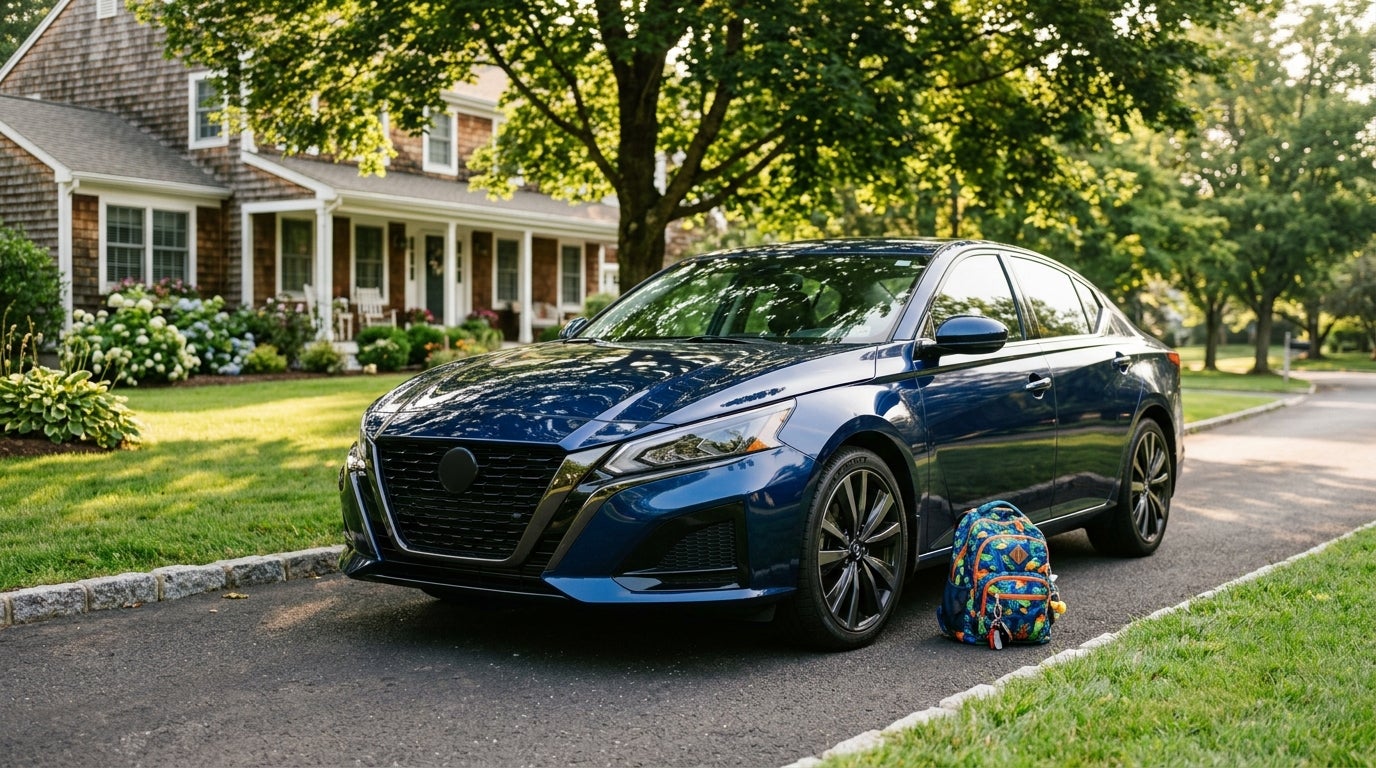
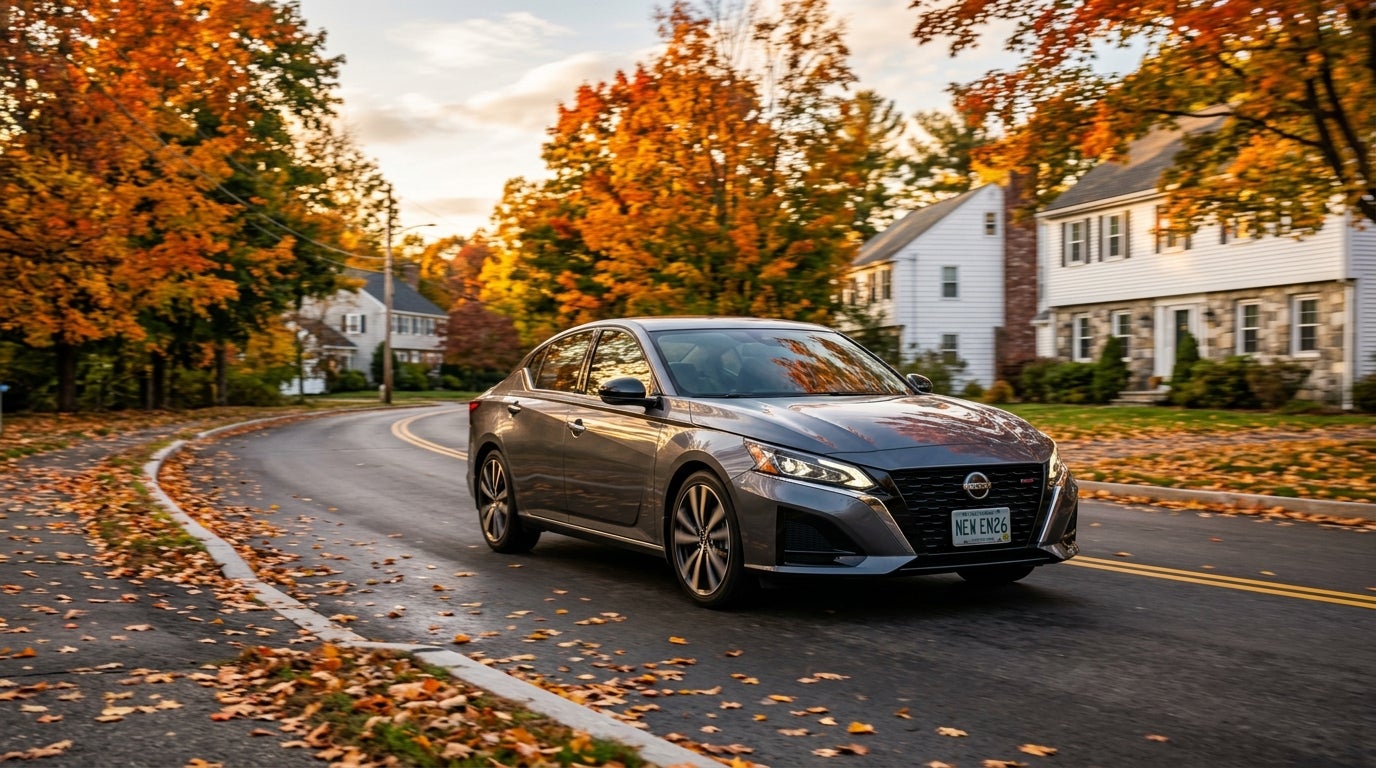
The 2026 Nissan Altima is the right choice for Wallingford families and daily commuters who want a reliable, fuel-efficient midsize sedan with room for five and a comfortable, tech-equipped cabin. The front-wheel-drive SV starts at $27,580 and returns up to 36 mpg highway, while the all-wheel-drive SR AWD tops the range at $30,480 with 182 hp and confident all-season traction. Four trim configurations let buyers match budget, drivetrain, and feature priorities without overpaying. Table of Contents How Well Does the 2026 Nissan Altima Serve Wallingford Families and Commuters? A Look That Fits Historic and Modern Streetscapes: 2026 Nissan Altima Exterior Design Power and Efficiency for Your Daily Commute: 2026 Nissan Altima Performance Roomy Comfort for Family Trips and Local Outings Connectivity That Keeps You Linked on Your Wallingford-to-City Commute: Altima's Tech Features Safety Designed for School Runs and Neighborhood Drives Breaking Down 2026 Nissan Altima Pricing and Trims Warranty, Maintenance, and Service Insights for 2026 Nissan Altima Owners Awards and Expert Recognition Highlighting the 2026 Nissan Altima's Value and Appeal 2026 Nissan Altima Buyer Questions Answered How Well Does the 2026 Nissan Altima Serve Wallingford Families and Commuters? The short answer: very well. The Altima is built precisely for the kind of daily life that defines Wallingford — a morning commute down Route 5 toward New Haven, a school pickup in the afternoon, and a weekend run to the farmers market or Giuffrida Park with the whole family in tow. Edmunds describes the Altima as "roomy, comfortable and available with all-wheel drive" — and that assessment holds up when you look at what these four trims deliver. Seating for five passengers and about 15 cu ft of trunk space handle carpools and grocery runs with ease. The Xtronic continuously variable transmission keeps the ride smooth whether you're navigating Wallingford's rolling residential streets or merging onto I-91 toward Hartford. For buyers who want all-season confidence without stepping up to an SUV, the available all-wheel-drive versions — the SV AWD and SR AWD — add traction that earns its keep on wet autumn roads and the occasional snowy Connecticut morning. If you're ready to explore what's currently available, browse our current Altima inventory to see which trims and colors are in stock. Shoppers who prefer a pre-owned option can also browse our pre-owned vehicle listings for additional choices at a range of price points. The Altima competes in a strong segment alongside the Toyota Camry, Honda Accord, Hyundai Sonata, and Kia K5 — but its combination of AWD availability, a 5-star NHTSA overall safety rating, and a practical feature set at an accessible price point gives it a clear identity for buyers who prioritize dependability over flash. A Look That Fits Historic and Modern Streetscapes: 2026 Nissan Altima Exterior Design The 2026 Altima's exterior strikes a confident balance — it looks polished enough to park outside a New Haven office building and unpretentious enough to fit right in at a Wallingford neighborhood block party. The four-door sedan body stretches 192.9 inches in overall length with a 72.9-inch width, giving it a proportional, mid-size stance that's easy to park in tight downtown spots without sacrificing road presence. The SR and SR AWD trims carry a sportier character, sitting slightly lower at 56.9 inches tall compared to the SV's 56.8 inches (SV) and 57.3 inches (SV AWD). The SR's sport-tuned suspension also contributes to a slightly more planted look. Both SR trims ride on 19-inch alloy wheels, adding visual weight and a more dynamic stance. The SV and SV AWD start with 17-inch alloy wheels as standard, though the SV Premium Package upgrades those to 19-inch alloys. Color choices give the Altima real personality. The palette includes Super Black, Pearl White TriCoat, Gun Metallic, Gray Sky Pearl, Scarlett Ember Tintcoat, and Tactical Green Metallic — plus two-tone combinations pairing Gun Metallic, Pearl White TriCoat, Gray Sky Pearl, and Tactical Green Metallic with a contrasting Black Roof. The SR Midnight Edition package adds black trim around the side windows and a painted rear bumper for a more assertive look. Chrome bright trim around the side windows is standard on the SV and SV AWD, lending a classic sedan finish. If you're planning ahead on budget, you can get pre-qualified online before you visit, so you arrive knowing exactly where you stand. Power and Efficiency for Your Daily Commute: 2026 Nissan Altima Performance Thirty miles per gallon combined on a front-wheel-drive Altima — that's the number that matters most for the daily Wallingford-to-New Haven commute. Here's how the four trims stack up on powertrain and efficiency: Feature 2.5 SR 2.5 SR AWD 2.5 SV 2.5 SV AWD Horsepower 188 hp 182 hp 188 hp 182 hp Torque 180 lb-ft 178 lb-ft 180 lb-ft 178 lb-ft Drivetrain Front-wheel drive All-wheel drive Front-wheel drive All-wheel drive All trims share: Engine: 2.5L · Transmission: Xtronic Feature 2.5 SR 2.5 SR AWD 2.5 SV 2.5 SV AWD MPG 26 city / 36 hwy / 30 combined 25 city / 33 hwy / 28 combined 26 city / 36 hwy / 30 combined 25 city / 33 hwy / 28 combined Every Altima in this group uses a 2.5L inline four-cylinder engine paired with Nissan's Xtronic continuously variable transmission. The front-wheel-drive SR and SV produce 188 hp and 180 lb-ft of torque, while the all-wheel-drive SR AWD and SV AWD produce 182 hp and 178 lb-ft — a modest difference that reflects the additional drivetrain hardware, not a meaningful real-world performance gap. The Xtronic transmission is tuned to keep the engine in its efficiency sweet spot, which is exactly why the FWD trims reach 36 mpg highway. On the SR, the sport-tuned suspension — noted as an alternate sport-type setup in the catalog — sharpens the steering response without making the ride feel harsh on Wallingford's residential streets. The SR AWD and SV AWD add all-wheel drive with automatic engagement, giving the car confident footing on wet pavement and light snow without requiring any driver input. Edmunds observes that the Altima "handles smoothly and remains stable even when navigating fast, sweeping curves," which translates well to the gently rolling terrain around Wallingford and the highway ramps heading toward New Haven. The fuel tank holds about 16 gallons on the SR and SV (FWD), giving a calculated highway range of 486 miles between fill-ups. The AWD trims carry a 16-gallon tank with a calculated range of 448 miles. For a family that fills up once a week, the difference is roughly one extra stop per month. Roomy Comfort for Family Trips and Local Outings Five seats, about 15 cu ft of cargo space, and generous interior dimensions — the Altima is a practical family sedan that doesn't ask you to compromise on passenger comfort to get decent trunk room. Feature 2.5 SR 2.5 SR AWD 2.5 SV 2.5 SV AWD Curb weight 3,323 lbs 3,442 lbs 3,283 lbs 3,401 lbs All trims share: Seating: 5 · Cargo: about 15 cu ft Front headroom measures 39.1 inches and rear headroom comes in at 36.9 inches, which is enough for most adults to sit comfortably without feeling cramped. Front legroom is 43.8 inches — genuinely comfortable for longer drives to Hartford — and rear legroom is 35.2 inches, workable for school-age kids and comfortable for most adults on shorter trips. Shoulder room runs 58.2 inches up front and 57.1 inches in the rear, so three across in back is a realistic option for smaller passengers. The about 15 cu ft trunk is a practical shape — wide enough to load a stroller, deep enough for a weekend's worth of groceries, and the rear seat folds asymmetrically to extend the load floor when you need to carry longer items like fishing rods or sports equipment. Interior materials step up as you move through the trims. The SV and SV AWD come standard with cloth seating. The SR and SR AWD use upgraded cloth/velour as standard, with leather seating available through the SR Premium Package. Both SR trims include a leather-wrapped gear selector and a leather-wrapped steering wheel as standard, while the SV and SV AWD feature a standard steering wheel that upgrades to leather wrap with the SV Premium Package. The driver's seat offers four-way power adjustment on all trims, with electric height, reach, recline, and tilt. The SR Premium Package bumps the driver's seat to five-way power adjustment and adds an electric lumbar control — a welcome addition for commuters who log significant miles during the week. Front and rear center armrests, front and rear cup holders, and a full floor console with overhead partial console round out the cabin's everyday usability. Connectivity That Keeps You Linked on Your Wallingford-to-City Commute: Altima's Tech Features A 12.3-inch touchscreen is the Altima's centerpiece — and it's standard on the SR, SR AWD, and both premium packages for the SV lineup. The base SV and SV AWD start with an 8-inch touchscreen, which upgrades to the larger 12.3-inch display when you add the SV Premium Package or SV Special Edition package. The instrument cluster features a 7-inch TFT display across all four trims, keeping speed, range, and trip data clearly visible without distraction. Wireless Apple CarPlay and wireless Android Auto are standard on the SR and SR AWD, so your phone pairs automatically the moment you get in the car — no cable required. On the SV and SV AWD, Apple CarPlay and Android Auto are included in the SV Premium Package. All trims include Bluetooth connectivity, steering-wheel-mounted audio controls, satellite radio capability, and a standard 6-speaker audio system. The SR and SR AWD come with 2 USB charging ports up front and 2 in the rear as standard, plus a wireless charging pad. The SV and SV AWD include 2 front USB ports standard, with rear USB ports and the wireless charging pad added through the SV Premium Package. A 12V power outlet in the front rounds out the charging options on all trims. The Nissan Intelligent Key® system — which includes both keyless entry and keyless start — is standard across all four trims, so you never need to dig through a bag to get into the car. A push-button start is also standard on every trim. For SV and SV AWD buyers interested in connected services, the optional Nissan Connect Services package adds NissanConnect telematics, remote lock/unlock, remote vehicle start, remote climate control, theft alerts, vehicle diagnostics, and a 3 GB/month Wi-Fi hotspot for the first three months. That's a genuinely useful add-on for a family that wants to pre-condition the cabin on a cold Connecticut morning before the school run. Safety Designed for School Runs and Neighborhood Drives Every 2026 Altima in this group earned a 5-Star Overall Safety Rating from the National Highway Traffic Safety Administration — a meaningful credential for parents who put their kids in the back seat every day. The passive safety foundation is strong across all four trims: 10 airbags total, including front airbags for both driver and passenger, front and rear side airbags, front-and-rear side curtain airbags, and knee airbags for both front occupants. Front seat belts include pre-tensioners and height adjustment, rear outboard belts include pre-tensioners, and the rear center position uses a 3-point belt. LATCH child-seat anchors are also standard. The IIHS rates the Altima's LATCH system as Good, and the seat belt reminder as Good — both reassuring signals for families with young children. Active driver-assistance features are standard across all four trims. Intelligent Forward Collision Warning (I-FCW) monitors the road ahead and provides visual and acoustic warnings when a collision risk is detected, activating as low as 3 mph. Automatic emergency braking engages at low speed for both front and rear scenarios. Lane Departure Warning (LDW) alerts the driver when the vehicle drifts toward a lane marking without a turn signal. Blind Spot Warning (BSW) monitors the adjacent lanes and alerts you to vehicles in hard-to-see areas — particularly useful on the highway between Wallingford and Hartford. Rear Cross Traffic Alert (RCTA) uses radar to detect approaching cross traffic when backing out of a parking space or driveway. The SR Premium Package and SV Premium Package add ProPILOT Assist, Nissan's hands-on highway driving assistance system that combines adaptive cruise control with lane centering. The SR Premium Package also names this as Intelligent Cruise Control (ICC) with Full-Speed Range, which includes stop-and-go capability — so the car can slow to a complete stop in traffic and resume without driver input. The SR Premium Package further adds the Intelligent Around View Monitor (I-AVM), a 360-degree camera system that stitches together views from cameras around the car to display a bird's-eye perspective — making tight parking maneuvers in downtown Wallingford noticeably easier. All four trims also include a standard Rear Sonar System with camera and sensor-based rear parking guidance. Breaking Down 2026 Nissan Altima Pricing and Trims The four trims covered here span a $27,580 to $30,480 MSRP range before the $1,275 destination charge, giving buyers clear stepping stones based on drivetrain and feature priorities. Feature 2.5 SR 2.5 SR AWD 2.5 SV 2.5 SV AWD Base MSRP $28,980 $30,480 $27,580 $29,080 All trims share: Destination charge: $1,275 The SV at $27,580 is the most accessible entry point. It includes standard LED headlights, a 6-speaker audio system, Apple CarPlay and Android Auto (wired), a Rear Sonar System, Nissan Intelligent Key, push-button start, Blind Spot Warning, Rear Cross Traffic Alert, Lane Departure Warning, and automatic emergency braking. The SV's standard 17-inch alloy wheels and cloth seating keep the price down while delivering a well-rounded daily driver. The optional SV Premium Package unlocks the 12.3-inch touchscreen, wireless smartphone integration, ProPILOT Assist, a panoramic sunroof, heated front seats, a wireless charging pad, rear USB ports, and 19-inch alloy wheels — a meaningful upgrade for buyers who want more comfort and tech without moving to the SR. The SV AWD at $29,080 adds all-wheel drive to the SV's feature set, making it the practical choice for buyers who prioritize all-season traction at a reasonable price. The SR at $28,980 steps up with sport-tuned suspension, upgraded cloth/velour seating, a leather-wrapped steering wheel and gear selector, and the 12.3-inch touchscreen as standard. The optional SR Premium Package adds leather seating, heated front and rear seats, a panoramic sunroof, ProPILOT Assist with stop-and-go, the Intelligent Around View Monitor, and a 9-speaker audio system with subwoofer. The SR Midnight Edition package offers a blacked-out aesthetic with black window trim, a trunk spoiler, and painted rear bumper. The SR AWD at $30,480 combines the SR's sportier character with all-wheel drive, making it the most fully equipped option in this group for buyers who want both performance and all-season confidence. Warranty, Maintenance, and Service Insights for 2026 Nissan Altima Owners Nissan's standard warranty package covers the 2026 Altima with a 3-year/36,000-mile basic vehicle warranty, a 5-year/60,000-mile powertrain warranty, a 5-year anti-corrosion warranty, a 3-year/36,000-mile paint warranty, and 3-year/36,000-mile roadside assistance coverage. A 2-year/24,000-mile scheduled maintenance coverage is also included. For day-to-day ownership, the Altima's 2.5L four-cylinder engine and Xtronic CVT are among the more straightforward systems to maintain in the midsize sedan segment — no turbochargers or complex hybrid components to worry about. Regular oil changes, tire rotations, and fluid checks are the core of the maintenance schedule. When it's time for service, you can book your next appointment online at Barberino Nissan — the process takes just a few minutes and keeps your car on schedule without disrupting your week. For routine items that don't require a full service bay visit, our Nissan Express Service program is designed to get you in and out quickly, which is exactly what busy families and commuters need. If you're also exploring Nissan's electric vehicle lineup alongside the Altima, our team can walk you through EV maintenance options and current service specials as well. Awards and Expert Recognition Highlighting the 2026 Nissan Altima's Value and Appeal The 2026 Nissan Altima carries a 5-Star Overall Safety Rating — National Highway Traffic Safety Administration (2025), which is the strongest independent endorsement available for passenger vehicle safety. That rating reflects performance across frontal, side, and rollover test categories, and it's a direct data point for any family prioritizing occupant protection. On the editorial side, Edmunds describes the Altima as "roomy, comfortable and available with all-wheel drive" with "distinct value for a midsize sedan" — a measured, credible assessment from one of the industry's most trusted review sources. Their observation that the car "handles smoothly and remains stable even when navigating fast, sweeping curves" speaks directly to the kind of confident, predictable driving that Wallingford's mix of residential streets and highway on-ramps demands. These recognitions align with what the Altima actually delivers in the real world: a composed, practical sedan that earns its keep through reliability and everyday usability rather than flashy claims. If you're also considering trading in your current vehicle, you can get an estimate on your trade-in value before you visit — knowing that number upfront makes the conversation at the dealership much more straightforward. 2026 Nissan Altima Buyer Questions Answered Q: Which trim is the best value for a Wallingford family on a budget? The SV AWD at $29,080 (plus $1,275 destination) hits the practical sweet spot for most Wallingford families. It includes all-wheel drive for Connecticut winters, standard safety features including Blind Spot Warning and automatic emergency braking, Apple CarPlay and Android Auto, and seating for five. Adding the SV Premium Package brings in the 12.3-inch touchscreen, heated seats, wireless charging, and ProPILOT Assist — making it a fully equipped family sedan without reaching the SR AWD's price point. Q: Does the Altima have enough cargo space for family outings? Yes. The about 15 cu ft trunk is consistent across all four trims and handles the practical demands of family life — a stroller, a week of groceries, sports gear for a Giuffrida Park outing, or fishing equipment for a trip to the Quinnipiac River valley. The rear seat folds asymmetrically to extend the load floor when you need more room for longer items. Q: Is the AWD worth the extra cost for Connecticut winters? For buyers who commute year-round and don't want to think about traction on snowy mornings, the $1,500 premium from FWD to AWD (SV to SV AWD, or SR to SR AWD) is a reasonable investment. The AWD system engages automatically, requires no driver input, and all four trims come standard with all-season tires. The trade-off is a modest drop in fuel economy — from 30 combined to 28 combined mpg. Q: What does the SR Premium Package add, and is it worth it? The SR Premium Package adds leather seating, heated front and rear seats, a panoramic sunroof with one-touch operation, ProPILOT Assist with stop-and-go adaptive cruise control, the Intelligent Around View Monitor (360-degree camera), a 9-speaker audio system with subwoofer, a heated steering wheel, and dual-zone automatic climate control. For commuters who spend significant time on I-91 or Route 15, the ProPILOT Assist and stop-and-go cruise control alone justify the package for many buyers. Q: How do I see what's currently in stock at Barberino Nissan? The easiest way is to browse our new Nissan inventory online — you can filter by trim, color, and drivetrain to narrow down exactly what you're looking for before you visit. Our team at 505 N Colony Rd, Wallingford, CT 06492 is also happy to answer questions by phone at (203) 265-1611, or you can get directions to our showroom and come see the Altima in person. Schedule a test drive today and experience the comfort and safety your family deserves. © 2026 Barberino Nissan. All rights reserved. Vehicle specification data © JATO Dynamics Limited.