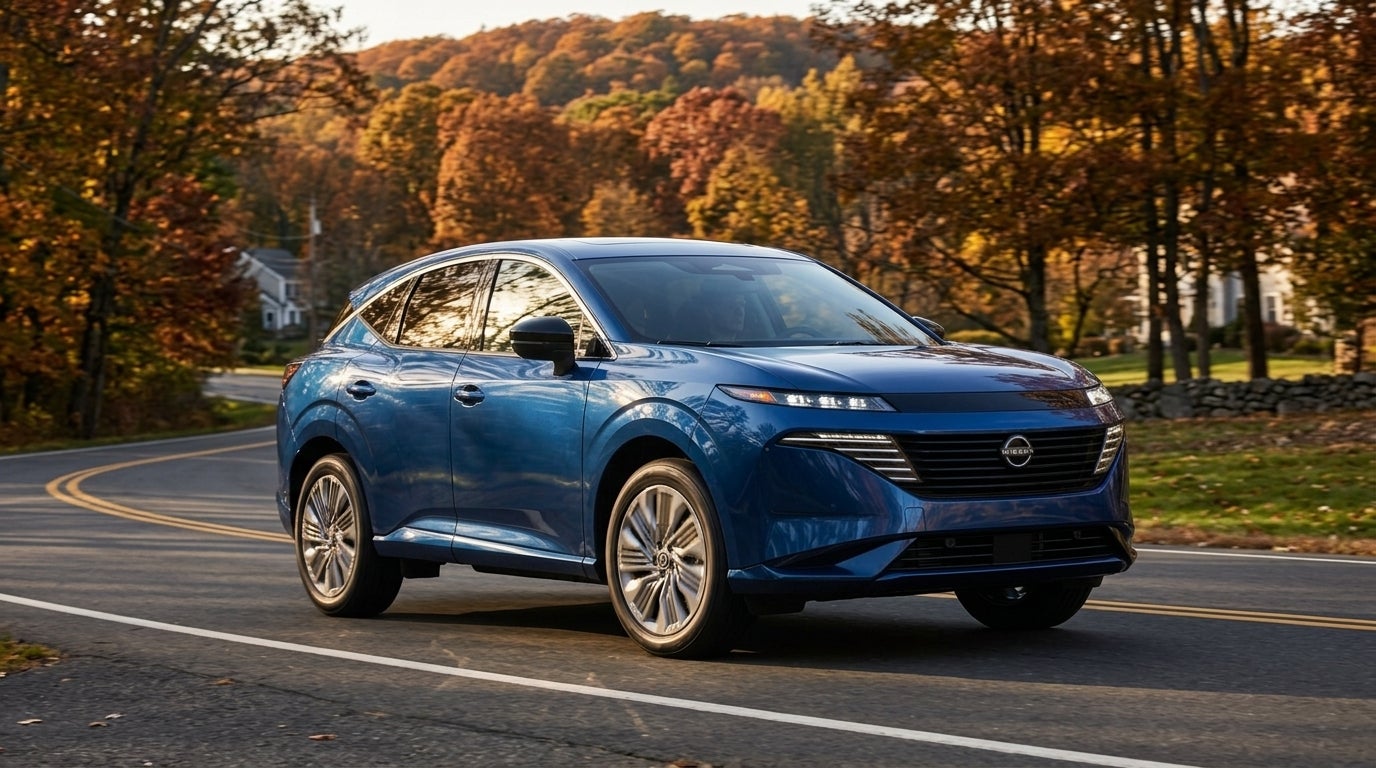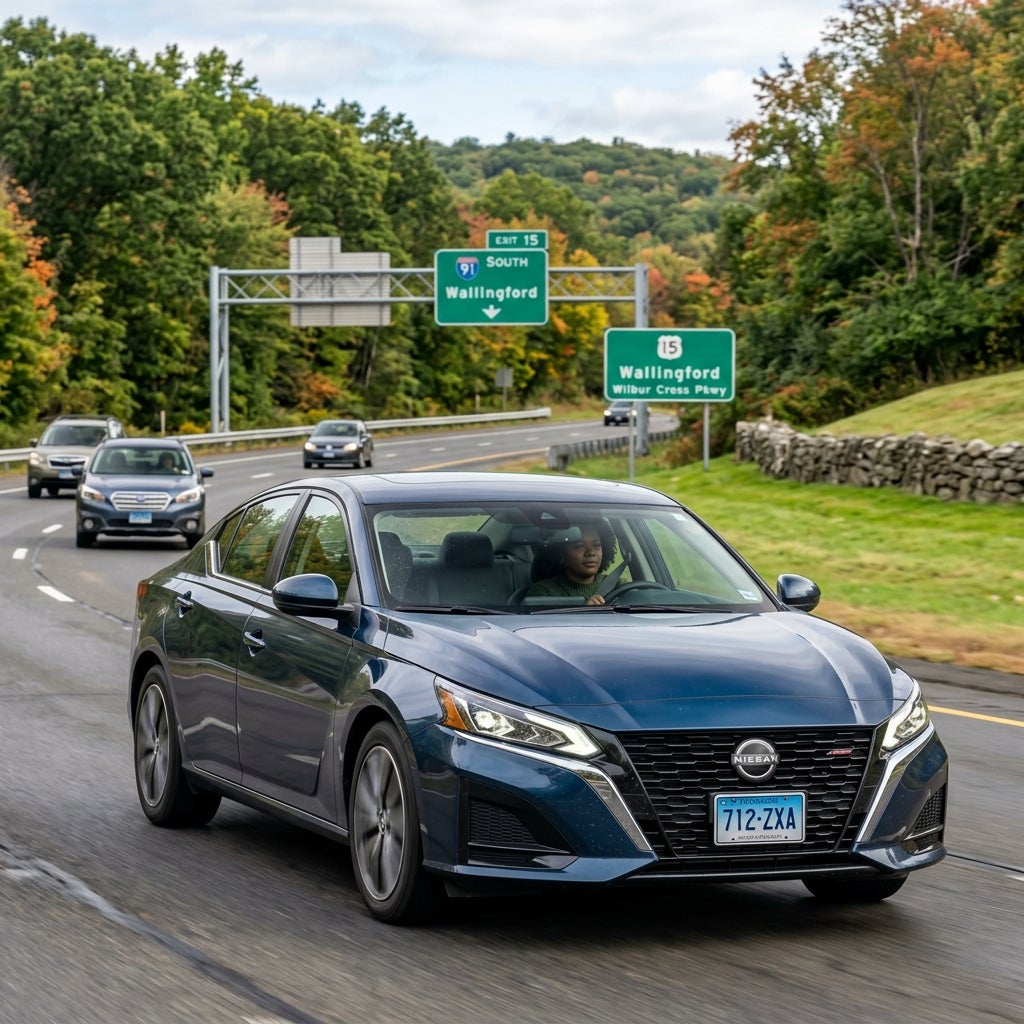

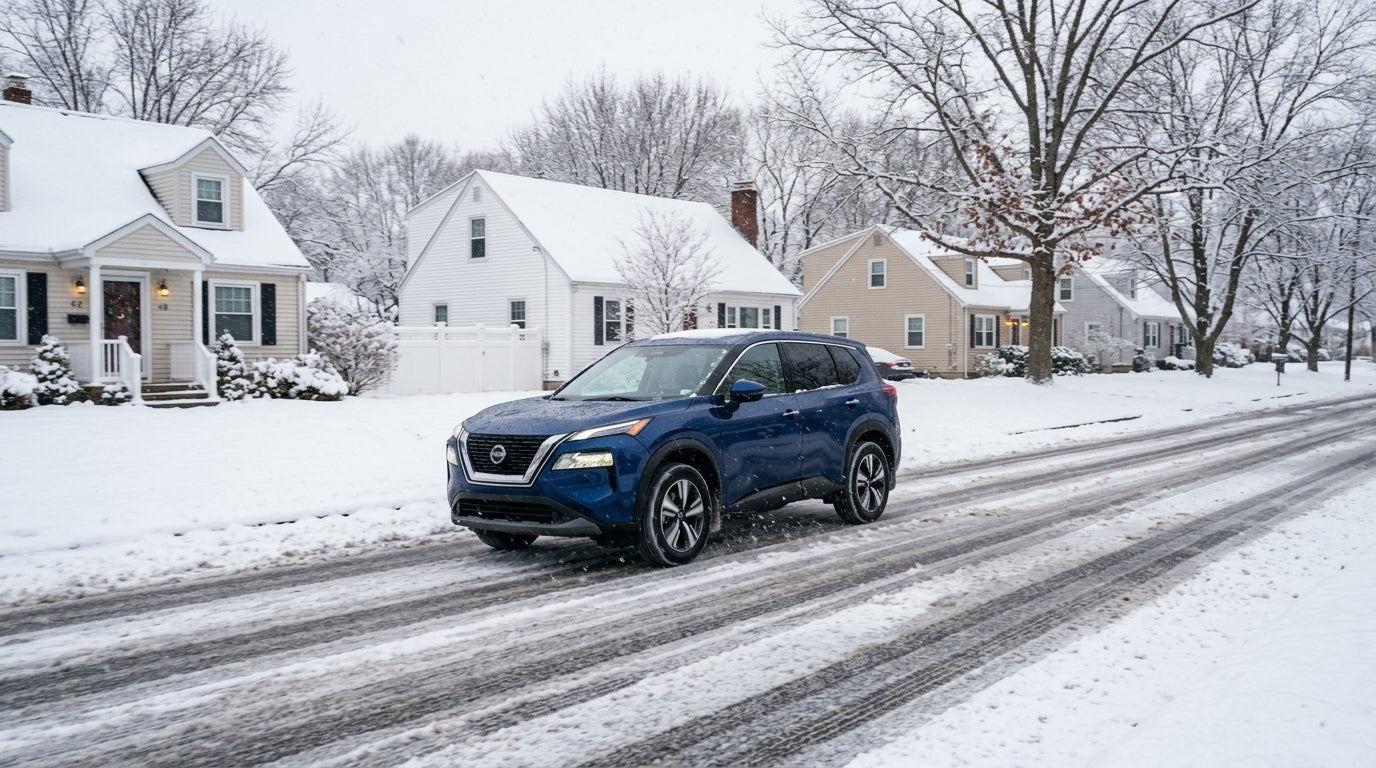
The Nissan Rogue handles snow exceptionally well when equipped with Nissan Intelligent All-Wheel Drive, offering up to 8.2 inches of ground clearance, standard torque distribution that transfers up to 50 percent of power to the rear wheels, and specialized drive settings like Snow mode. Powered by a 1.5-liter VC-Turbo engine delivering 225 lb-ft of torque, it maintains steady low-speed traction on slushy, frozen surfaces while safety technologies work in tandem to prevent wheel slip.
When winter weather impacts daily travel across Wallingford, navigating packed slush, freezing rain, and uneven road surfaces requires a crossover engineered for adaptability. Ground clearance plays a major role in keeping the undercarriage elevated above heavy snow accumulation, preventing the chassis from bottoming out on unplowed neighborhood streets or along the Quinnipiac River valley.
Beyond physical ground clearance, vehicle stability depends on how electronic safety systems manage traction. The Rogue coordinates its Xtronic CVT with Automatic Emergency Braking and traction control systems to regulate engine output when surface friction drops suddenly. Rather than allowing the tires to spin freely on black ice, the crossover monitors wheel rotation thousands of times per second to brake spinning wheels and redirect engine power to the tires with firm contact.
For drivers who want total confidence during cold-weather commutes, ensuring your vehicle is equipped with the right drivetrain and properly calibrated safety systems is essential. To inspect a crossover in person or test out drivetrain features, you can explore our showroom location or give our team a call at (203) 265-1611 for detailed specification guidance.
Table of Contents
- How Does Nissan Rogue Snow Mode Work and When Should You Use It?
- When Should You Use Snow Mode Versus Off-Road or Eco Mode in Winter?
- How Does Nissan Intelligent AWD Differ From Traditional 4WD and Honda CR-V AWD?
- What Are the Recommended Winter Tire Pressure and Fluid Settings for a Nissan Rogue?
- Frequently Asked Winter Driving Questions for the Nissan Rogue
- Getting Your Nissan Rogue Winter-Ready
How Does Nissan Rogue Snow Mode Work and When Should You Use It?
Snow mode softens initial throttle sensitivity and adjusts transmission shift points to prevent tire spin when accelerating from a complete stop on icy or slushy roads. On models equipped with Nissan Intelligent All-Wheel Drive, selecting this setting instructs the vehicle to pre-emptively route engine torque to the rear wheels before front-wheel slippage occurs.
Rotating the drive mode dial on the center console instantly alters how the engine, transmission, and all-wheel-drive system respond to pedal inputs. Under normal driving conditions in Auto mode, the Rogue operates primarily as a front-wheel-drive crossover to maximize fuel efficiency, engaging the rear axle only when sensors detect traction loss. In contrast, Snow mode changes this behavior by engaging a proactive system baseline:
- Throttle Mapping: The computer dampens accelerator pedal response, ensuring that aggressive foot pressure results in a gradual, controlled increase in power rather than a sudden burst that breaks tire grip.
- Transmission Ratios: The Xtronic CVT adjusts its effective gear ratios to maintain lower engine revolutions, reducing torque spikes at the driven wheels.
- Torque Distribution: Up to 50 percent of the engine's 225 lb-ft of torque is locked into the rear axle during initial acceleration to pull the vehicle forward smoothly.
- Brake-Based Traction Control: The system applies subtle braking force to individual slipping wheels, acting as a limited-slip differential to transfer momentum across the axle.
Commuters frequently ask our service team whether Snow mode should remain engaged during a full drive or turned off once reaching plowed highways. We recommend keeping Snow mode active whenever pavement remains covered in slush, hard-packed snow, or patchy ice. Once roads are clear and dry, returning the dial to Auto mode allows the crossover to optimize fuel economy without unnecessary rear-axle drag. Drivers researching winter-ready crossovers can browse our new Nissan Rogue crossover lineup or check our full selection of new Nissan models to compare available drivetrain configurations.
Engine & Performance
Powertrain specs by trim
| Feature | Dark Armor | Dark Armor AWD | Platinum AWD | Rock Creek AWD |
|---|---|---|---|---|
| Engine | 1.5L | 1.5L | 1.5L | 1.5L |
| Horsepower | 201 hp | 201 hp | 201 hp | 201 hp |
| Torque | 225 lb-ft | 225 lb-ft | 225 lb-ft | 225 lb-ft |
| Transmission | Xtronic | Xtronic | Xtronic | Xtronic |
| Drivetrain | Front-wheel drive | All-wheel drive | All-wheel drive | All-wheel drive |
Engine & Performance (continued)
| Feature | S AWD | S FWD | SL AWD | SL FWD |
|---|---|---|---|---|
| Engine | 1.5L | 1.5L | 1.5L | 1.5L |
| Horsepower | 201 hp | 201 hp | 201 hp | 201 hp |
| Torque | 225 lb-ft | 225 lb-ft | 225 lb-ft | 225 lb-ft |
| Transmission | Xtronic | Xtronic | Xtronic | Xtronic |
| Drivetrain | All-wheel drive | Front-wheel drive | All-wheel drive | Front-wheel drive |
Engine & Performance (continued)
| Feature | SV AWD | SV FWD |
|---|---|---|
| Engine | 1.5L | 1.5L |
| Horsepower | 201 hp | 201 hp |
| Torque | 225 lb-ft | 225 lb-ft |
| Transmission | Xtronic | Xtronic |
| Drivetrain | All-wheel drive | Front-wheel drive |
When Should You Use Snow Mode Versus Off-Road or Eco Mode in Winter?
You should engage Snow mode on icy, slushy, or hard-packed snow surfaces to actively suppress tire spin, whereas Off-Road mode is designed for deep, loose terrain like sand, gravel, or unplowed mud where controlled wheel rotation helps maintain forward momentum. Eco mode dampens throttle sensitivity to boost fuel economy on clear highways, but it can make engine response feel overly sluggish when trying to push through heavy snow banks.
Understanding when to toggle between drive settings prevents drive-line strain and ensures the chassis responds predictably to changing road conditions. Each setting alters engine parameters and traction control interventions differently:
- Snow Mode: Ideal for frozen, slick surfaces. It actively suppresses wheel spin and smooths out power delivery from the 1.5-liter VC-Turbo engine so tires maintain physical adhesion with slippery pavement.
- Off-Road Mode: Calibrated for loose, uneven surfaces like unpaved dirt or deep, unplowed snow drifts. This setting allows a controlled amount of wheel spin, enabling the tire tread to dig through top layers of loose debris to find firm ground beneath.
- Eco Mode: Best suited for dry, open highway cruising. It optimizes climate control power draw and reduces throttle sensitivity for maximum fuel efficiency, achieving up to an EPA-estimated 36 hwy mpg on standard front-wheel-drive models or 35 hwy mpg on all-wheel-drive variants.
Using Eco mode in severe winter weather is generally discouraged because the delayed throttle response can make it difficult to feather the gas pedal when navigating icy intersections or pulling out of a snowed-in parking spot. Matching the drive mode to exact surface conditions ensures smooth handling and protects driveline components from unnecessary wear. Drivers considering a versatile pre-owned crossover can explore our pre-owned Nissan inventory to find all-wheel-drive models equipped with selectable drive modes.
How Does Nissan Intelligent AWD Differ From Traditional 4WD and Honda CR-V AWD?
Nissan Intelligent All-Wheel Drive operates automatically by constantly monitoring vehicle speed and wheel slip, transferring up to 50 percent of available power to the rear wheels on demand before returning to front-wheel drive for fuel efficiency. Unlike traditional 4-wheel-drive systems that require manual driver engagement and lock the axles together, or competing systems like Honda CR-V Real Time AWD that operate without a dedicated driver-selectable snow drive mode dial, Nissan provides both automatic power distribution and customizable throttle mapping.
Traditional 4WD systems found on heavy-duty trucks utilize a mechanical transfer case with locked high- and low-range settings. While excellent for extreme off-roading, traditional 4WD cannot be driven on dry or partially cleared pavement without causing severe driveline binding and tire scrubbing during sharp turns. Nissan Intelligent All-Wheel Drive eliminates this hassle by using electronic center couplings that allow wheels to rotate at different speeds during turns while continually modulating torque output.
When compared to compact crossover rivals like the Honda CR-V, the Rogue offers a distinct operational advantage. Honda's Real Time AWD system relies entirely on fully automated computer logic without giving the driver a physical console dial to force a dedicated snow calibration. The Rogue features a dedicated console dial that allows the driver to select Snow mode, proactively tailoring throttle sensitivity and transmission ratios before entering a hazardous roadway.
Navigating icy stop-and-go city traffic near Long Island Sound in New Haven requires rapid system response at traffic lights and coastal bridges. The ability to combine automatic power transfer with a specialized snow setting gives drivers enhanced control on slick inclines. For shoppers exploring low-emission options alongside capable crossovers, our all-electric Nissan lineup offers advanced electrified mobility, while current vehicle owners can easily value your trade-in online toward their next upgrade.
What Are the Recommended Winter Tire Pressure and Fluid Settings for a Nissan Rogue?
The recommended cold tire pressure for a Nissan Rogue typically ranges between 33 and 35 PSI as listed on the driver's door placard, but cold ambient temperatures cause tire pressure to drop by roughly 1 PSI for every 10-degree Fahrenheit drop in outside air temperature. For reliable cold-weather operation, the 1.5-liter VC-Turbo engine requires 0W-20 full synthetic engine oil for rapid lubrication during cold starts, paired with winter-grade windshield washer fluid rated down to at least -20°F.
As winter temperatures drop, motorists often see the horseshoe-shaped Tire Pressure Monitoring System (TPMS) warning light illuminate on the instrument cluster. This alert frequently stems from cold air contraction rather than a physical nail puncture. Driving on significantly underinflated tires reduces fuel economy, causes rapid outer shoulder tread wear, and compromises wet-weather braking grip.
Maintaining proper fluid viscosity is equally critical for protecting engine internals during freezing starts:
- Engine Oil: Using 0W-20 full synthetic engine oil ensures low-viscosity fluid flow through the turbocharger bearings and variable-compression mechanisms immediately upon ignition, preventing metal-on-metal wear in sub-zero conditions.
- Washer Fluid: Standard summer washer fluids freeze inside fluid reservoirs and spray nozzles, risking cracked pumps and obscured vision. Filling the reservoir with a winter-grade formula rated to -20°F prevents freeze-ups during highway salt spray.
- Coolant Mixture: Ensuring a 50/50 ethylene glycol and water ratio prevents radiator fluid from freezing and damaging the engine block.
Proper seasonal preparation protects the vehicle's interior cargo and hauling capacity. Models like the SL AWD and Platinum AWD offer up to about 36.5 cu ft of rear cargo volume (or about 32 cu ft on S and SV trims) to carry winter emergency gear, sand bags, and heavy equipment, backed by a payload capacity reaching up to 1,166 lbs on S AWD trims. To ensure your vehicle is fully prepared for cold weather, owners can schedule a service appointment online with our maintenance department or get pre-qualified online for seasonal accessory upgrades.
Dimensions & Capacity
Capacity and dimensions by trim
| Feature | Dark Armor | Dark Armor AWD | Platinum AWD | Rock Creek AWD |
|---|---|---|---|---|
| Seating | 5 | 5 | 5 | 5 |
| Cargo | 31.6 cu ft | 31.6 cu ft | 36.5 cu ft | 31.6 cu ft |
| Curb weight | 3,530 lbs | 3,657 lbs | 3,737 lbs | 3,713 lbs |
| Payload | 1,111 lbs | 1,116 lbs | 996 lbs | 972 lbs |
Dimensions & Capacity (continued)
| Feature | S AWD | S FWD | SL AWD | SL FWD |
|---|---|---|---|---|
| Seating | 5 | 5 | 5 | 5 |
| Cargo | 31.6 cu ft | 31.6 cu ft | 36.5 cu ft | 36.5 cu ft |
| Curb weight | 3,607 lbs | 3,607 lbs | 3,694 lbs | 3,565 lbs |
| Payload | 1,166 lbs | 1,034 lbs | 1,039 lbs | 1,076 lbs |
Dimensions & Capacity (continued)
| Feature | SV AWD | SV FWD |
|---|---|---|
| Seating | 5 | 5 |
| Cargo | 31.6 cu ft | 31.6 cu ft |
| Curb weight | 3,657 lbs | 3,530 lbs |
| Payload | 1,116 lbs | 1,111 lbs |
Frequently Asked Winter Driving Questions for the Nissan Rogue
Q: Does Nissan Intelligent All-Wheel Drive stay on all the time?
A: Nissan Intelligent All-Wheel Drive operates on demand rather than full-time. Under clear driving conditions, the system directs power exclusively to the front wheels to optimize fuel economy. When sensors detect front-wheel slippage or rapid acceleration, the system instantly transfers up to 50 percent of engine torque to the rear wheels to stabilize tracking.
Q: Can I drive in Snow mode on dry pavement without damaging the drivetrain?
A: Yes, driving in Snow mode on dry pavement will not cause mechanical damage to the drivetrain. Unlike traditional 4WD systems with locked transfer cases, Snow mode simply adjusts electronic throttle sensitivity and transmission shift mapping. However, keeping it engaged on dry roads can result in sluggish acceleration and slightly reduced fuel efficiency.
Q: What should I do if my TPMS warning light comes on during a cold morning?
A: Measure your tire pressures with an accurate gauge when the vehicle has been parked for at least three hours. If ambient cold has lowered the pressure below the door-jamb placard recommendation, inflate the tires to the correct PSI. The warning light will turn off after driving a short distance once proper pressure is restored.
Q: Does the Nissan Rogue offer heated features for winter driving comfort?
A: Higher trim levels and available cold-weather packages include heated front seats, heated rear outboard seats, a heated steering wheel, and heated side mirrors. Additionally, Remote Engine Start with Intelligent Climate Control allows drivers to warm the cabin and defrost windows remotely using the MyNISSAN app before entering the vehicle.
Q: Are winter snow tires still necessary if my vehicle has All-Wheel Drive?
A: While Intelligent AWD and Snow mode maximize engine power distribution, all-wheel drive cannot create traction where none exists on sheer ice. Dedicated winter tires feature specialized soft rubber compounds and dense siping that significantly shorten braking distances on ice and hard snow, making them a valuable safety upgrade alongside AWD.
Drivers cross-shopping sedan options alongside crossovers can also explore our new Nissan Altima inventory for all-wheel-drive car options.
Getting Your Nissan Rogue Winter-Ready
Preparing your crossover for winter driving involves combining driver-assist technology with routine mechanical maintenance. Utilizing Snow mode, maintaining cold tire pressures between 33 and 35 PSI, and ensuring your engine is filled with 0W-20 full synthetic engine oil supports safety and performance across icy roadways.
Our factory-certified technicians are available to complete comprehensive winter inspections, tire rotations, battery load tests, and system calibrations to keep your vehicle performing reliably. To schedule seasonal care or learn more about crossover features, visit our dealership or contact our team directly at (203) 265-1611 today.
© 2026 Barberino Nissan. All rights reserved.